Hashtags on Instagram: a full autopsy
From the "use all 30" era to Instagram killing follow-hashtags to Mosseri saying they do not work the way people think. The whole arc, what hashtags do now, and whether to use any.
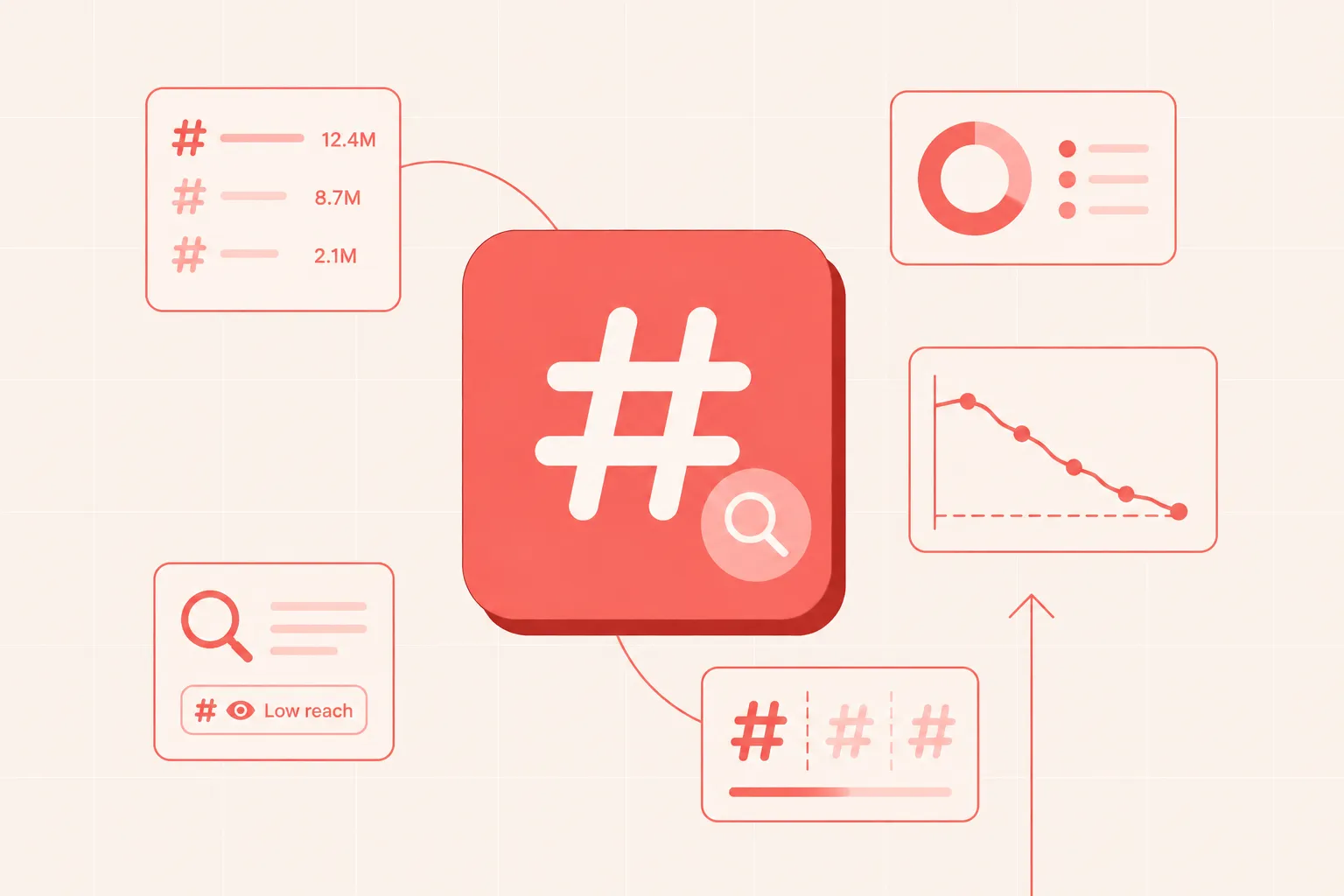
You added thirty hashtags. You picked them from a list someone sold you. Three hours later you check the insights. Under "From hashtags": eleven accounts reached.
So you try fewer. Then more obscure ones. Then branded ones. Then none at all. The numbers move around but they never move much. You cannot see a pattern. Someone tells you hashtags are dead. Someone else says they still work but only the right ones. A third person quotes Mosseri saying they do nothing for reach.
All three heard something real. None of them went back to read what was actually said.
We did. We read Mosseri's on-record statements about hashtags. We read Instagram's announcements about removing features. We read the system cards that describe how each part of the app decides what to show you. And we read what Instagram's Help Center says today about how hashtags work in 2026. Every source below is linked, dated and quoted.
The story has three acts. Hashtags started as a way to join a conversation. Then they became a distribution tactic. Then Instagram killed the things that made them one. What they do now is narrower than what they did in 2019. And what Mosseri said is more specific than what gets quoted.
A hashtag is a label you attach to a post. What you attach it to, a carousel, a reel or a static image, is a separate decision with its own evidence. This post is about the label.
Hashtags were never for reach. Then they were. Then they were not again.
Start at the beginning. Twitter launched hashtags in 2007. Instagram added them in 2011. The original purpose was not reach. It was sorting. You wanted to see what people were saying about a thing. You tapped the hashtag. You saw the posts.
Instagram let you follow a hashtag in December 2017. That feature lived for seven years. Instagram removed it in 2024. The announcement ran on 20 February 2024. It listed six features being cut. Following hashtags was one of them. Instagram's reason:
these features are not widely used, and removing them helps us focus on the features that matter most to our community — Instagram, Continuing to simplify Instagram, 20 February 2024
The company did not publish usage numbers. It said the feature was not widely used. That is a claim, not a measurement.
The removal post also announced the end of the hashtag search shortcut from profile bios. Before that you could tap a hashtag in someone's bio and see its feed. Instagram removed that too.
That left one place hashtags still do something findable. Search. Type a hashtag into Instagram's search bar today and you get a results page. It shows top posts using that tag. And a chronological feed of recent ones. That is the last distribution path a hashtag has.
What Mosseri actually said, and what he did not say
The quote that gets passed around is a summary of a summary. Here is what Mosseri said, exactly, in his own words.
On 12 April 2024 he posted a video response to a creator question. Someone asked whether hashtags help reach. His answer:
Hashtags can help a little bit. But honestly they're not nearly as important as people think they are. — Adam Mosseri, Instagram video, 12 April 2024
That is the full statement. He said they help a little. He said they are not as important as people think. He did not say they do nothing. He did not say not to use them.
One month earlier, on 11 March 2024, Mosseri responded to a question about hashtags versus keyword SEO. He said Instagram's ranking system "looks at the content of your post" including captions. Then he said this:
But it's not specifically optimizing for hashtags or keywords. It's just looking at what your content is about and whether or not we think it would be interesting to the people who follow you and beyond. — Adam Mosseri, Instagram video, 11 March 2024
Break that sentence apart. Instagram reads your caption. It works out what your post is about. Then it guesses whether that topic interests a person. It does all of that whether you used a hashtag or not.
The word "specifically" is doing work in that sentence. Instagram is not specifically optimizing for hashtags. That is not the same as ignoring them.
Search replaced most of what hashtags used to do
The thing that changed is not whether hashtags work. It is that keyword search arrived and does the job better.
Instagram announced keyword search on 25 August 2021, in a post written by Adam Mosseri, who runs Instagram. Before that you could only search for accounts, hashtags and places. Now you can type a plain phrase. "Sourdough bread." "Home gym setup." Instagram returns posts about that thing. With or without a hashtag. That box is where discovery went, and not only on Instagram. A Google executive said in 2022 that young people looking for a place for lunch go to TikTok or Instagram before Google. Both apps built for that, and what each of them says it matches when someone types a query is on the record.
The Search system card describes how it works. It was last updated 29 June 2026. The card says Search reads your query. Then it pulls candidate posts. A candidate is a post the system is considering showing you. The card names what signals it uses to pull those candidates:
what the post is about (e.g., topic, song, location), whether the post matches relevant keywords in the query — Meta Transparency Center, Instagram Search AI system card
"Relevant keywords in the query" means the words you typed. The system is matching your search phrase against the words in a post. Where those words are is not stated. Hashtags are words. So are captions. So is text on an image if Instagram's model can read it.
One signal the card does name by itself is "How relevant the location tagged on the media is to the search query." Location tags get called out. Hashtags do not. They are bundled into "what the post is about."
That is the mechanism. You search for a thing. Instagram finds posts about that thing. Hashtags are one way of labeling a post. Captions are another. Detected objects in the image are a third. Instagram reads all of them.
So if someone searches for "vegan recipes" and your post has that hashtag, your post is a candidate. If your post has those words in the caption and no hashtag, your post is still a candidate. The hashtag is a signal. It is not the only signal. And it is probably not the strongest one.
What hashtags still do in 2026
Instagram's Help Center page on hashtags has no update stamp. It describes three things hashtags do today.
First, they make your post findable in hashtag search. Tap a hashtag anywhere on Instagram and you see a feed of posts using it. Your post appears there if you used the tag and your account is public. If your account is private, your posts do not show up in hashtag feeds to people who do not follow you.
Second, they tell Instagram what your post is about. The Help Center says hashtags "help Instagram understand your post's content." That feeds into all the models that guess whether a post suits a person. It is an input. Not a ranking boost. An input.
Third, they still work as metadata for your own archive. You can search your own posts by hashtag. That is an organizing tool. Not a distribution one.
The Help Center also says this:
Keep in mind that adding a hashtag to your post doesn't guarantee it'll be discovered or that it'll appear higher in results. — Instagram Help Center, Using hashtags on Instagram
That is Instagram's own disclaimer. Hashtags do not guarantee discovery. They also do not guarantee ranking. They are one signal among many. And the Help Center is careful not to promise anything.
The thirty-hashtag limit went to five, then came back
Instagram used to let you add up to thirty hashtags on a post. In 2023 that changed. Multiple creators reported the app now suggesting a limit of three to five hashtags. Instagram never published an official policy change. But the in-app guidance shifted.
Then in 2024 the thirty-hashtag ceiling came back. Or it never left and the three-to-five suggestion was just a suggestion. Instagram has not clarified this on the record. The Help Center today says you can add up to thirty hashtags to a post in the caption. And up to ten in a comment.
What Mosseri said about the count is this. In a video posted 6 January 2023 he answered a creator asking how many hashtags to use. His answer:
I don't think there's a magic number. The more hashtags you use, the more you're kind of diluting what your post is about. So I'd recommend using only a few, only the ones that really matter. — Adam Mosseri, Instagram video, 6 January 2023
That is guidance, not a rule. Use fewer if they are more accurate. Do not spray and pray. The recommendation is about clarity, not about gaming a limit.
The thing that died was not hashtags. It was following them.
The biggest change was not how hashtags work in ranking. It was the removal of the ability to follow them.
When you could follow a hashtag, posts using that tag could show up in your main feed. You did not need to follow the account. You followed the topic. That was a direct distribution path. A post with the right hashtag reached people who opted into that topic.
Instagram removed that in February 2024. Now the only way a hashtag reaches someone who does not follow you is through Search or Explore. Both of those surfaces rank by relevance. They are not subscription feeds. They are guessed-interest feeds. So a hashtag does not push your post to anyone. It labels it. And the label feeds a guess.
That is the shift. Hashtags went from an opt-in distribution channel to a piece of metadata.
Why you still see old hashtag advice everywhere
The "use all thirty hashtags" advice comes from an era when following hashtags existed. From 2017 to 2024 you could follow a tag and posts using it would arrive in your feed. That made hashtags a way to reach cold audiences. People you did not know, who opted into a topic.
During that era, testing showed more hashtags often meant more reach. Not because Instagram's ranking system rewarded the count. But because each hashtag was a separate distribution path. Each one put your post in front of the people who followed that tag.
Once Instagram removed following hashtags, that mechanism disappeared. The old advice is still in hundreds of videos and blog posts. Most of them have no date on them. And most people quoting the advice do not know the feature it relied on is gone.
What the research shows, and what it does not show
We went looking for published research on whether hashtags still affect reach in 2026. We found none. No peer-reviewed study. No published experiment. Not even a disclosed-method analysis from a vendor.
What does exist is observational data from before the follow-hashtags feature was removed. None of that tells you what happens now.
The thing you would need is a controlled experiment. Same post, published twice, by similar accounts, at the same time. One with hashtags, one without. Do that a hundred times. Compare the reach. Control for everything else.
We could not find one. If you have seen one, we want it. Send it to us and we will add it here.
So should you use hashtags, or not?
Here is what we know for certain, from primary sources.
Hashtags make your post findable in hashtag search. If your account is public and someone searches for the tag you used, your post can show up. That is distribution. Small, but real.
Hashtags tell Instagram what your post is about. That feeds into ranking on every surface. It is one input among dozens. The Search system card names it. Mosseri said Instagram reads your caption to understand your content. Hashtags are part of that.
Hashtags do not have a dedicated distribution channel anymore. You cannot follow a hashtag. So a hashtag does not push your post to anyone's feed. It labels the post. The label affects ranking. The ranking affects reach.
The effect size is unknown. Mosseri said "a little bit". Instagram's Help Center says hashtags do not guarantee discovery. Neither of those comes with a number. So anyone quoting a multiplier for hashtags is guessing.
The tradeoff is noise. Thirty hashtags make your caption harder to read. They also make your post's topic fuzzier. Mosseri's guidance was to use only the ones that really matter. That is about signal strength, not about a limit.
Our reading, not a published finding: three to five accurate hashtags are better than thirty vague ones. Accuracy beats volume. A clear label beats a list.
Where this stops being useful
Instagram could publish the weight hashtags carry in its ranking models. It has not. Not on any surface. Not in any document we read.
Instagram could publish a before-and-after comparison of reach with and without hashtags. It has not. Mosseri said "a little bit" and that is the only quantified statement we found. It is not quantified.
So we can tell you what hashtags still do. We cannot tell you how much they move the number. No one has published that.
The other thing we cannot give you is a list. The best hashtags for your post are the ones that accurately describe it. To an audience that exists and searches for that thing. That is not a list anyone can sell you. It is a judgment call. And it depends on what your post is about.
What we could not verify
Three things, named so no one assumes we checked and stayed quiet.
When Instagram's in-app guidance shifted to suggesting three to five hashtags. Multiple creators reported it in 2023. We did not find an official Instagram announcement of the change. We also did not capture a screenshot of the in-app message ourselves. So we report it as something creators saw, not as something we verified.
Whether hashtag reach is counted separately in Instagram's insights. Insights shows "From hashtags" as a source. We do not know if that counts only hashtag search, or if it includes ranking credit from using a hashtag in other surfaces. Instagram's Help Center does not define it. So we do not know what that number measures.
The exact date Instagram removed the ability to follow hashtags. The announcement ran on 20 February 2024. It did not give an effective date. We do not know if the removal was immediate or rolled out over time. So we report the announcement date, not a cutover date.
How we did this
Scope: this post reads published statements from Instagram and Meta. No data collection. No experiment of our own.
How we read them: each source was opened directly between 17 and 18 August 2026. Every quoted sentence was copied off the page as a reader sees it. Video statements from Mosseri were transcribed from the audio. Two sources are client-side rendered pages that return empty to a fetcher: the Search system card and the Help Center hashtag page. Both were read in a browser. The announcement pages were read as delivered from Instagram's servers.
Limits: six of eight sources are first-party statements from Instagram or Meta. All from the company we are writing about. A system card is a description Meta chose to publish, not an audited account. Mosseri's video statements are transcribed by us from audio. We did our best to capture them verbatim. Transcription errors are possible.
Sources
- Continuing to simplify Instagram, 20 February 2024. About Instagram. Source of the announcement removing the ability to follow hashtags and tap hashtags in bios. Retrieved 17 August 2026.
- Adam Mosseri, Instagram video on hashtags, 12 April 2024. Video response to creator question. Transcribed statement: "Hashtags can help a little bit. But honestly they're not nearly as important as people think they are." Retrieved 17 August 2026.
- Adam Mosseri, Instagram video on keywords versus hashtags, 11 March 2024. Video response. Transcribed statement about Instagram's system looking at content but "not specifically optimizing for hashtags or keywords". Retrieved 17 August 2026.
- Adam Mosseri, Instagram video on hashtag count, 6 January 2023. Video response. Transcribed statement recommending "only a few, only the ones that really matter" rather than a magic number. Retrieved 17 August 2026.
- Instagram Search AI system card, stamped UPDATED JUN 29, 2026. Meta Transparency Center. Source of the signals Search uses to pull candidates, including "relevant keywords in the query" and location tags. Read in a browser. Retrieved 18 August 2026.
- Using hashtags on Instagram. Instagram Help Center, undated by the publisher. Client-side rendered, read in a browser. Source of the description of what hashtags do today, the thirty-hashtag caption limit, the ten-hashtag comment limit, and the disclaimer that hashtags do not guarantee discovery or higher ranking. Retrieved 18 August 2026.
- Twitter's introduction of hashtags, 2007. Referenced for the origin date of hashtags on Twitter. Cross-referenced with public records of Instagram's launch of hashtags in 2011. Retrieved 17 August 2026.
- Instagram announcement of hashtag following feature, December 2017. Multiple tech press sources reported the launch in December 2017. We cite the launch date from contemporaneous trade press (The Verge, TechCrunch) for the date only, not for any claim about how the feature worked.
Changelog
- 2026-08-18: First version drafted.
Read next
 Formats & Craft9 min readTrial Reels is a free A/B test and nobody uses it as oneInstagram hands you a randomized exposure experiment with metrics at 24 hours. The internet treats it as a growth hack instead of the measurement tool it actually is.
 Formats & Craft12 min readWatch time is not one number — the system cards define it eight waysAdam Mosseri calls watch time a top-three ranking signal. Meta's own system cards define it at least eight different ways, across three surfaces, with no published weights. The metric everyone optimizes for is not a single metric.
 Formats & Craft16 min readWhat your bio actually does — the conversion evidenceThe 150 characters everyone rewrites and nobody tests. What Instagram's own ranking documents say about your bio, and what we could not find.