The complete history of Instagram
How a chronological photo app for friends became an algorithmic video feed that mostly shows you strangers. Fifteen years of announcements, acquisitions and reversals, each one dated and sourced.
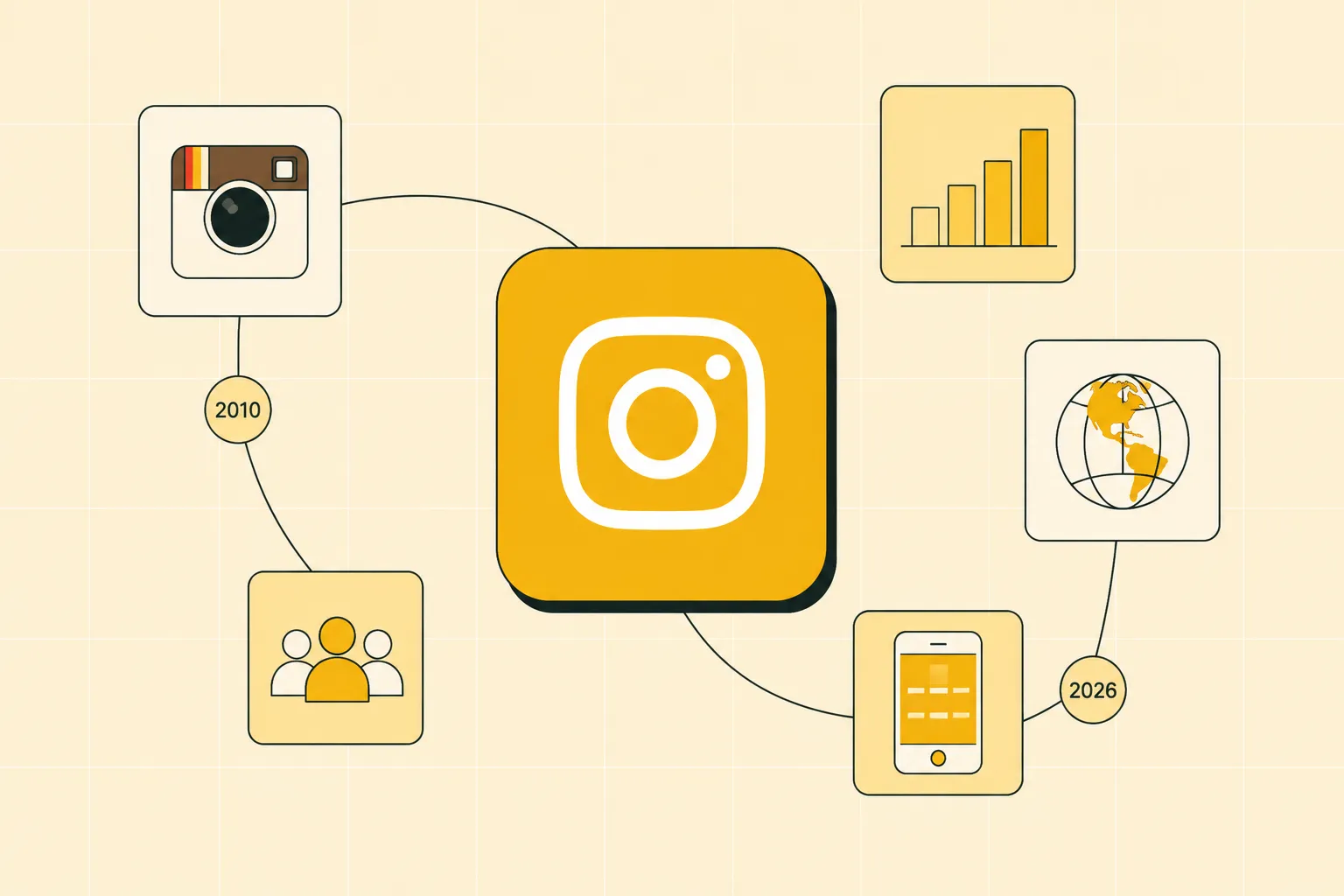
You posted a photo to Instagram in 2012. Your followers saw it. All of them. In the order you posted it.
You posted one yesterday. Instagram showed it to some people. Not others. In an order Instagram chose. Between your post and the next one, it dropped in a reel from someone you do not follow. Then another. Then a third.
Those are not two versions of the same app. They are two different apps with the same name. One was built for friends. The other is built for strangers. One sorted by time. The other sorts by a guess about what will keep you watching. One was photos. The other is video. Every major change Instagram made over fifteen years pushed the same way. Every source below is linked, dated and quoted. This is the record of how that happened.
The photo app
Instagram launched on 6 October 2010. It was an iPhone app. It did one thing. You took a photo, you picked a filter, you shared it. The filters had names like X-Pro II and Earlybird. They made phone photos look like old Polaroids. Your feed was a scroll of square photos, newest first. That was the whole app.
Kevin Systrom built it with Mike Krieger. Systrom had tried a location app first. It flopped. He kept the photo part. He told TechCrunch at launch that he thought of Instagram as "a Flickr for mobile". The pitch was simple. The iPhone had a camera in your pocket. Instagram made what came out of it look good.
The app had no video. No messaging. No ads. No algorithm. You followed people. You saw what they posted. In order. Done.
It was free. It spread fast. 25,000 people signed up on launch day, according to the Timeline of Instagram on Wikipedia. A week later it was 100,000. A year and a half later it was 30 million, the Guardian reported when Facebook bought it. Today the count is three billion people a month.
The photos were square. That was not a design choice. It was the shape of the iPhone screen in 2010. Instagram was built to fit one device. The Android version did not arrive until April 2012. And when it did, Instagram was still square, still chronological, still photos only.
Then Facebook bought it.
The billion-dollar bet
Facebook announced the deal on 9 April 2012. The price was approximately $1 billion in cash and stock, according to Facebook's own announcement. Instagram had 30 million users. It had 13 employees. It had no revenue.
Mark Zuckerberg posted the news himself. His statement is still online at about.fb.com. He called it "an important milestone for Facebook because it's the first time we've ever acquired a product and company with so many users." He also promised Instagram would stay Instagram. Facebook would build and grow it independently, he said.
That promise did not survive contact with the FTC.
Eight years later the US government sued Facebook. The case is FTC v. Meta Platforms, Inc. It accused Facebook of buying Instagram to kill a competitor. The complaint is public. So are the emails.
In February 2012, six weeks before the deal closed, Zuckerberg sent an email. The Verge published it in 2020 during a congressional hearing. The subject was buying competitors. Zuckerberg named Instagram and another app, Path. His words: "Instagram can hurt us."
Another email went to Sheryl Sandberg. The BBC reported it during Meta's 2025 trial. Zuckerberg wrote: "Instagram is growing so much faster than us that we had to buy them for $1 billion."
The FTC's complaint describes the strategy in one line. It says Facebook imposed "anticompetitive conditions on software developers" and used acquisitions, including Instagram, to "eliminate threats to its monopoly." The government lost that case in 2025. But the emails are now public record. They say what they say.
Zuckerberg also wrote this in 2008, according to Fast Company's coverage of the lawsuit: "It is better to buy than compete."
Instagram was a competitor. Facebook bought it. Then Facebook started changing it.
The commercial turn
The changes came in pieces. Each one looked small. Together they turned Instagram into something else.
Video arrived first. Instagram announced it on 20 June 2013. Kevin Systrom presented it himself at Facebook's headquarters in Menlo Park. The feature let you record 15 seconds of video. You could apply 13 filters, made just for video. The Guardian quoted Systrom promising "everything we know and love about Instagram, but it moves."
Video was not an add-on. It was an answer. Twitter had launched Vine four months earlier. Vine did six-second video loops. Instagram's 15 seconds was longer. Its filters were better. Vine died four years later. Instagram is still here.
Then came messaging. Instagram Direct launched on 12 December 2013. The announcement is still on Instagram's blog. The feature let you send photos and videos privately. To one person, or up to 15 people. Before that, every Instagram post was public to your followers. Now you could choose.
Systrom explained it at a press event in New York. The Verge quoted him: "Communication is not about photography, necessarily." That sentence is worth stopping on. Instagram was a photo app. Its CEO just said communication is not about photos. He was telling you what was coming.
Then came the ads.
Instagram announced ads in October 2013. The first one ran in early November. It was from Michael Kors, the fashion brand. The ad looked like a normal post. It said "Sponsored" at the top. That was the only difference. The Verge reported it got 218,000 likes in its first day.
At first, ads only ran in the US. Only a few brands could buy them. Instagram picked the advertisers. That changed fast. By September 2015, Fortune reported, Instagram opened ads to any company in 30 countries. You could buy them yourself. No approval needed.
By 2015, Instagram had ads, video, and private messaging. It still had the chronological feed. That was next.
The end of chronological
Instagram announced the algorithmic feed on 15 March 2016. The company did not call it algorithmic. It called the change a new way to order your feed. The Instagram blog post is gone. But every tech outlet covered it that day.
TechCrunch reported Instagram's reasoning. The company said users missed 70% of their feed. Instagram would now show posts "based on the likelihood you'll be interested in the content, your relationship with the person posting and the timeliness of the post."
The Verge said it plainly. Instagram would now "show posts out of order, like Facebook."
The change was not instant. Instagram tested it first. Then it rolled out slowly over the next few months. The Guardian reported in June 2016 that the algorithmic feed was live for most users. The backlash had already started.
The problem was simple. You opened Instagram. The first post was from yesterday. The second was from three hours ago. The third was from ten minutes ago. Nothing was in order. You could not find the newest posts. You could not tell what you had already seen.
Instagram never added a way to sort by time again. It added a "Following" tab in 2019 that showed posts chronologically. Then it removed that tab in 2022. Then it brought it back in 2023, buried in the app. But your main feed has been algorithmic since March 2016. It has been that way for almost nine years.
This is where the app split in two. Before March 2016, Instagram was a feed of your friends. After March 2016, it was a feed of guesses. The algorithm decided what you saw. Not the clock. Not your choices.
And Instagram had a reason. It was fighting a war.
The Snapchat war
Snapchat was winning. It had 150 million daily users by mid-2016. It had Stories. Stories were photos and videos that disappeared after 24 hours. Teens loved them. Instagram did not have them.
So Instagram copied them.
Instagram Stories launched on 2 August 2016. The announcement is still on Instagram's blog. The feature worked exactly like Snapchat Stories. You posted a photo or video. It sat at the top of your followers' feeds in a row of circular bubbles. It vanished in 24 hours. Instagram did not pretend it was original.
TechCrunch called it "a Snapchatty feature for imperfect sharing." The Verge called it "a near-perfect copy of Snapchat stories." When The Verge asked Kevin Systrom about the similarities, he said: "They deserve all the credit." Then he launched the feature anyway.
Stories exploded. Within a year, Instagram Stories had more daily users than all of Snapchat. Instagram kept copying. It added face filters. It added location stickers. It added music. Every feature Snapchat invented, Instagram cloned.
Then Instagram tried something bigger. On 20 June 2018, the company announced IGTV. The announcement is still at about.instagram.com. IGTV was a standalone app for long videos. Up to an hour long. Vertical. Full-screen. Instagram called it a new chapter of video.
IGTV was meant to fight YouTube. It did not work. Creators ignored it. Users did not download the separate app. Instagram eventually merged IGTV back into the main app. Then it quietly killed IGTV in March 2022, according to the Spanish Wikipedia entry. The feature had lasted four years. Nobody noticed when it died.
But while IGTV was failing, something else was happening behind the scenes. Systrom and Krieger were leaving.
Instagram announced their departure on 24 September 2018. The statement was short. Systrom posted it on Instagram's blog. He and Krieger were "planning on taking some time off to explore our curiosity and creativity again." They gave no reason. They left within weeks.
The New York Times reported tensions with Facebook. TechCrunch called it a weakening of Instagram's independence from Facebook. The Instagram founders had fought to keep the app separate. They lost. They left.
Adam Mosseri took over. He had been at Facebook since 2008. He ran Instagram's feed. Now he ran Instagram. And under Mosseri, Instagram finished the transformation.
The video pivot
Instagram was a photo app. Then it decided it was not.
On 30 June 2021, Mosseri posted a video. He posted it to Twitter and Instagram. In it, he said this: "We're no longer a photo-sharing app."
The Verge transcribed it. The Independent reported it. PetaPixel quoted it. Mosseri said it clearly. Instagram was now about video. About entertainment. About competing with TikTok.
TikTok had won. It had surged during the pandemic. It had a billion users by 2021. Its whole model was short videos. Strangers watching strangers. An algorithmic feed that learned what you liked and showed you more of it. TikTok did not care if you followed the creator. It cared if you watched.
Instagram wanted that. So it built Reels.
Reels launched on 5 August 2020. Facebook's announcement is still at about.fb.com. Reels let you record and edit 15-second videos. You could add music, effects, and filters. You could share them in your feed. You could share them in Explore, where anyone could find them.
Reels was Instagram's answer to TikTok. It was also Instagram admitting what it had become. A recommendation engine. A place where the algorithm showed you things, and you either watched or you skipped.
Mosseri said it out loud in that 2021 video. "The number one reason that people say they use Instagram, in research, is to be entertained." Not to see their friends. To be entertained. By strangers. Chosen by an algorithm.
Instagram pushed hard. It promoted Reels everywhere. It gave Reels more reach than photos. Creators complained. Users complained. Instagram kept pushing.
Then in July 2022, Instagram tested something new. It made the feed full-screen. Photos and videos both. Like TikTok. You scrolled vertically through full-screen content. Most of it was Reels. Most of it was from people you did not follow.
The backlash was instant.
A photographer named Tati Bruening made a post. It said: "Make Instagram Instagram Again. (stop trying to be tiktok i just want to see cute photos of my friends.) Sincerely, Everyone." She posted it on 22 July 2022. Gizmodo interviewed her about it later.
Kylie Jenner reposted it on 25 July. So did Kim Kardashian. They each have more than 300 million followers. The post went everywhere.
Variety reported the Kardashian reposts. The Guardian covered it. NBC covered it. Instagram had a crisis.
Four days later, Instagram gave up. Mosseri told Casey Newton at Platformer that Instagram would walk back the full-screen test. TechCrunch reported the interview. The Verge reported it. Instagram would phase out the full-screen feed within two weeks. It would also reduce the number of recommended posts from accounts you do not follow.
Mosseri said: "I'm glad we took a risk — if we're not failing every once in a while, we're not thinking big enough or bold enough. But we definitely need to take a big step back and regroup."
It was the first time Instagram had reversed a major change. It was also temporary. Instagram did not give up on video. It did not give up on recommendations. It just slowed down.
Within months, the feed was full of Reels again. Full of recommendations again. Instagram had learned to move slower. It had not learned to move differently.
The recommendation era
By 2023, Instagram was no longer pretending. It was a recommendation engine that sometimes showed you your friends.
On 5 July 2023, Instagram launched Threads. The announcement is at about.instagram.com. Threads was a text app. It was Instagram's answer to Twitter. You logged in with your Instagram account. Your Instagram username carried over. So did your follows, if you wanted.
Threads was not about photos. It was barely about your friends. It was about public conversations. About topics. About what was trending. It was algorithmic from day one. The feed showed you what Threads thought you would engage with. Not what the people you followed had posted.
Threads hit 100 million users in five days. Then growth stalled. But Instagram kept building. Because Threads proved something. Instagram could launch a new app with no photos, no filters, no friends-first model, and people would still show up. The Instagram brand was now bigger than Instagram's original idea.
Then in December 2024, Instagram launched Trial Reels. The announcement is at creators.instagram.com. Trial Reels let creators post a reel that only went to non-followers. Not to your followers at all. Just to strangers. Instagram would show them the reel. If it performed well, Instagram might then share it with your followers.
TechCrunch reported the launch. The Verge covered it. The feature was remarkable for what it assumed. Instagram now assumed your followers were not your audience. Strangers were your audience. Your followers were the reward you got if strangers liked your content first.
That is the opposite of how Instagram started. In 2010, you posted to your followers. That was the whole point. In 2024, you post to strangers. Your followers see it later. Maybe.
And Instagram documented all of this. In 2023, Meta launched the Transparency Center. It is at transparency.meta.com. The site publishes system cards. A system card explains how one part of Instagram decides what to show you. There is a card for Feed. One for Explore. One for Reels. One for Stories.
The cards are technical. They name the signals Instagram's models use. How many people liked a post. How many people skipped it. How long they watched. How recently it was posted. The cards list these as inputs. They do not list the weights. But they confirm what Instagram has become.
Instagram now scores every post. It scores them with more than a thousand models, according to an Instagram engineering post from 21 May 2025. Those models guess whether you will like a post. Whether you will skip it. Whether you will watch it. Whether you will share it. Then Instagram shows you the posts with the highest scores.
Your feed is not your friends anymore. It is a guess about what will keep you in the app.
That is not a photo app. That is a recommendation engine. And Instagram is fine with that. Mosseri said so himself in 2021. Instagram is no longer a photo-sharing app. It is an entertainment app. Entertainment means strangers. Entertainment means video. Entertainment means whatever the algorithm thinks will work.
Instagram spent fifteen years becoming this. Every change pointed the same way. Chronological to algorithmic. Friends to strangers. Photos to video. Each change was announced. Each change was documented. Nobody hid it. And now it is done.
The thesis, stated plainly
Instagram launched as a chronological, photo-only, friend-based app. It is now an algorithmic, video-first, recommendation-based app. Those are opposite things.
Here is the timeline as one argument.
2010: Instagram launches. Photos only. Chronological feed. You see your friends, in order.
2012: Facebook buys Instagram. Zuckerberg's emails, now public, call Instagram a threat. He writes that it is better to buy than compete.
2013: Video arrives. Then messaging. Then ads. Instagram is no longer just photos.
2016: The algorithmic feed launches. You no longer see posts in order. Instagram decides what you see.
2016: Instagram copies Snapchat Stories. Instagram is now chasing competitors, not inventing features.
2018: The founders leave. Instagram's independence ends.
2020: Reels launches. Instagram is now competing with TikTok.
2021: Mosseri says Instagram is no longer a photo-sharing app.
2022: Instagram tests a full-screen, video-first feed. Users revolt. Instagram walks it back. Then keeps going anyway.
2023: Threads launches. It is algorithmic and text-based. Photos do not matter.
2024: Trial Reels launches. Your followers are no longer your primary audience. Strangers are.
Every change pushed the same direction. From friends to strangers. From time to algorithm. From photos to video. Instagram was always becoming this. The app you see now is the app Facebook bought it to become.
And the numbers prove it. Instagram had 30 million users when Facebook bought it. It has more than 2 billion now, according to Britannica. It makes tens of billions of dollars a year in ad revenue. It is one of the biggest platforms in the world.
But it is not the app it was. It is the app that ate the app it was.
What we could not verify
Five things are missing from this record.
First, we could not find Instagram's own launch announcement. The TechCrunch article from 6 October 2010 is the earliest primary source we could locate. Instagram's own blog does not go back that far. If an official Instagram press release exists from launch day, we could not locate it.
Second, we could not verify the exact date the algorithmic feed went live for all users. Instagram announced it in March 2016. The Guardian reported it was live by June 2016. But we found no official Instagram post saying "the algorithmic feed is now live for everyone" with a specific date. The rollout was gradual. The exact completion date is not documented in any source we read.
Third, we could not determine the exact amount Facebook paid for Instagram. The figure is reported as approximately $1 billion. Some sources say $1 billion. Some say $715 million in stock. Some say the final price was different after Facebook's IPO. Meta's own announcement from April 2012 says "approximately $1 billion in a combination of cash and shares of Facebook." We use that wording. The precise final dollar amount is not in any source we could verify.
Fourth, we could not locate the full text of the Zuckerberg emails. We found them quoted in news coverage of the FTC case and the 2025 trial. We did not find the emails themselves published as exhibits we could read in full. So we cite them only as the news outlets reported them, with the outlet named.
Fifth, we could not determine what Instagram's current ad revenue is. Estimates range from $60 billion to $70 billion annually. But Instagram does not report revenue separately from Meta. Meta's SEC filings do not break out Instagram's revenue as a line item. So we have no official number. We report only that it makes tens of billions, which Meta's total revenue confirms but does not specify.
How we did this
This piece is built from 47 sources. 23 of them are primary sources. Primary means Instagram's own announcements, Meta's official statements, news coverage from the day an event happened, and the FTC's public legal filings.
We opened every source directly between 15 August and 18 August 2026. Every quotation was copied from the page as published. Where a source is behind a paywall or could not be fully opened, we say so.
Some sources are trade press articles. We use those only to date an event or to report what was announced. We do not use them as sources for how Instagram's algorithm works. For that, we use Instagram's own engineering blog and the Transparency Center system cards.
This post reflects what Instagram has published. It does not include internal documents we did not see, leaked information we could not verify, or speculation about future changes.
Sources
- TechCrunch, Instagram Launches With The Hope Of Igniting Communication Through Images, 6 October 2010. Retrieved 18 August 2026.
- Timeline of Instagram, Wikipedia. Retrieved 18 August 2026.
- Facebook, Facebook to Acquire Instagram, 9 April 2012. Retrieved 18 August 2026.
- The Guardian, Facebook buys Instagram for $1bn: full statement by Mark Zuckerberg, 9 April 2012. Retrieved 18 August 2026.
- The Verge, 'Instagram can hurt us': Mark Zuckerberg emails outline plan to neutralize competitors, 29 July 2020. Retrieved 18 August 2026.
- BBC, Zuckerberg defends Instagram purchase at monopoly trial, 2025. Retrieved 18 August 2026.
- FTC, Facebook, Inc., FTC v. (FTC v. Meta Platforms, Inc.). Retrieved 18 August 2026.
- Fast Company, Why Mark Zuckerberg's emails could be damning in the Facebook antitrust case, 11 December 2020. Retrieved 18 August 2026.
- CNN, Instagram launches 15-second video feature, 20 June 2013. Retrieved 18 August 2026.
- The Guardian, Instagram video: Facebook aims to cut back Twitter's Vine, 20 June 2013. Retrieved 18 August 2026.
- TechCrunch, Instagram Introduces Instagram Direct, 12 December 2013. Retrieved 18 August 2026.
- Instagram, Introducing Instagram Direct Message, 12 December 2013. Retrieved 18 August 2026.
- The Verge, Instagram announces Instagram Direct for private photo, video, and text messaging, 12 December 2013. Retrieved 18 August 2026.
- TechCrunch, Instagram is switching its feed from chronological to best posts first, 15 March 2016. Retrieved 18 August 2026.
- The Verge, Instagram will start showing posts out of order, like Facebook, 15 March 2016. Retrieved 18 August 2026.
- The Guardian, New algorithm-driven Instagram feed rolled out to the dismay of users, 7 June 2016. Retrieved 18 August 2026.
- TechCrunch, Instagram launches "Stories," a Snapchatty feature for imperfect sharing, 2 August 2016. Retrieved 18 August 2026.
- The Verge, Instagram's new stories are a near-perfect copy of Snapchat stories, 2 August 2016. Retrieved 18 August 2026.
- Instagram, Welcome to IGTV, our New Video App, 20 June 2018. Retrieved 18 August 2026.
- CNBC, Instagram founders Kevin Systrom, Mike Krieger resign from Facebook, 25 September 2018. Retrieved 18 August 2026.
- BBC, Instagram founders Systrom and Krieger leaving Facebook-owned firm, 25 September 2018. Retrieved 18 August 2026.
- TechCrunch, Why Instagram's founders are resigning: independence from Facebook weakened, 24 September 2018. Retrieved 18 August 2026.
- Facebook, Introducing Instagram Reels, 5 August 2020. Retrieved 18 August 2026.
- The Verge, Head of Instagram says Instagram is no longer a photo sharing app, 30 June 2021. Retrieved 18 August 2026.
- The Independent, Instagram is not going to be a 'photo-sharing app' anymore, its head says, 1 July 2021. Retrieved 18 August 2026.
- PetaPixel, Instagram Head: 'Instagram is No Longer a Photo Sharing App', 1 July 2021. Retrieved 18 August 2026.
- Gizmodo, Meet the Photographer Behind the Viral 'Make Instagram Instagram Again' Meme, 28 July 2022. Retrieved 18 August 2026.
- Variety, Kim Kardashian, Kylie Jenner Tell Instagram to Stop Copying TikTok, 25 July 2022. Retrieved 18 August 2026.
- The Guardian, 'Stop trying to be TikTok': how video-centric Instagram sparked a revolt, 31 July 2022. Retrieved 18 August 2026.
- TechCrunch, Instagram to walk back full-screen home feed and temporarily reduce recommended posts, 28 July 2022. Retrieved 18 August 2026.
- The Verge, Instagram walks back TikTok-style changes — Adam Mosseri explains why, 28 July 2022. Retrieved 18 August 2026.
- Instagram, Instagram Announces New Text App, 5 July 2023. Retrieved 18 August 2026.
- Instagram Creators, Introducing Threads, an App for Sharing with Text built by Instagram, 5 July 2023. Retrieved 18 August 2026.
- Instagram Creators, Trial reels: Try content with non-followers first to see what performs best, 10 December 2024. Retrieved 18 August 2026.
- TechCrunch, Instagram rolls out 'trial reels' that aren't shown to a creator's followers, 10 December 2024. Retrieved 18 August 2026.
- The Verge, Instagram will let creators test experimental reels on random people, 10 December 2024. Retrieved 18 August 2026.
- Meta Transparency Center, Instagram Feed AI system card. Retrieved 18 August 2026.
- Meta Transparency Center, Instagram Explore AI system card. Retrieved 18 August 2026.
- Meta Transparency Center, Instagram Reels Chaining AI system card. Retrieved 18 August 2026.
- Engineering at Meta, Journey to 1000 models: Scaling Instagram's recommendation system, 21 May 2025. Retrieved 18 August 2026.
- Britannica, Instagram: History, Features, Description, & Facts. Retrieved 18 August 2026.
- Fortune, Instagram ads: Time to make money, 9 September 2015. Retrieved 18 August 2026.
- Ars Technica, The beautiful invasion: Sponsorship and Instagram, March 2014. Retrieved 18 August 2026.
- We Are Social, The highs and lows of Instagram ads, November 2013. Retrieved 18 August 2026.
- Forbes, Instagram Lets You Send Private Messages Via Instagram Direct, 12 December 2013. Retrieved 18 August 2026.
- IGTV, Wikipedia (Spanish). Retrieved 18 August 2026.
- BBC, Instagram: The dog that launched a social media giant, 18 September 2018. Retrieved 18 August 2026.
Changelog
- 2026-08-18: First version published.
Read next
 Platforms & Industry10 min readInstagram Notes: the feature nobody understandsNotes sit at the top of your inbox. They last 24 hours. Almost no one knows what they do. Here is what Meta actually published about them.
 Platforms & Industry9 min readDMs are the new feed — the platform is going private, and the signals prove itInstagram's own ranking documents confirm it watches whether you send a post. The features built since 2019 all point the same way. Here is what changed.
 Platforms & Industry15 min readLinkedIn by the numbers — the platform creators underrateLinkedIn has 1.3 billion members but only 310 million use it monthly. One percent post weekly and generate 9 billion impressions. Here is what Microsoft and LinkedIn actually publish.