Alt text: an accessibility feature, and an SEO claim with no source
Alt text is for screen readers. Instagram said so in 2018. Then the SEO advice started. We read what Instagram actually publishes about search to see if the second claim has a source.
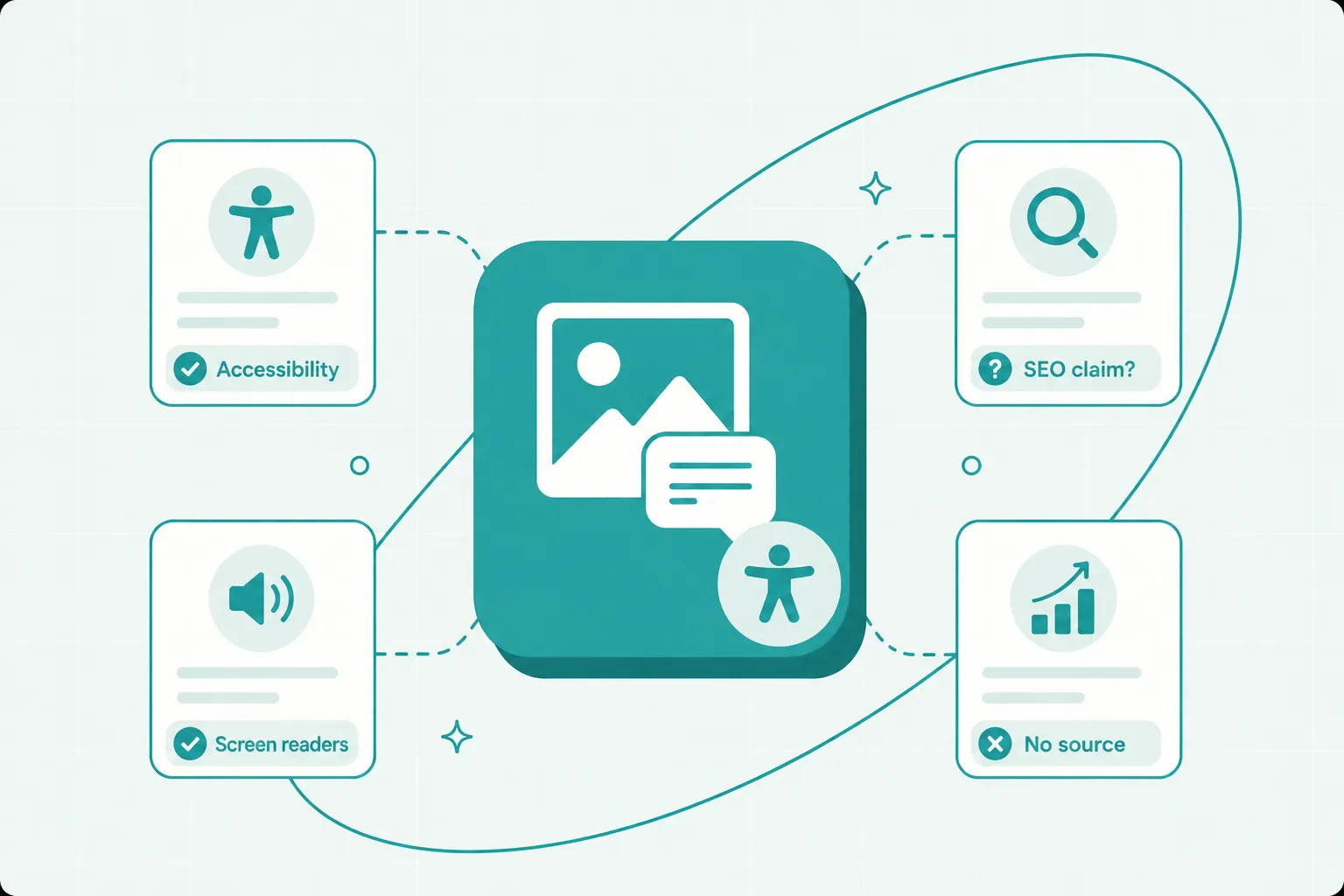
You added alt text to every post for a month. Someone on TikTok said it helps your reach. The numbers looked the same as before. So you opened Instagram's help page. It says alt text describes photos for screen readers. It says nothing about search.
Then you searched for advice. Every guide tells you alt text is an SEO tool now. Use your keywords. Instagram reads it. Your posts get found. That claim is everywhere. We went looking for where Instagram said it.
Instagram does publish what its search reads. The company puts out pages that explain how parts of the app decide what to show you. They are the same pages that document how Instagram scores a carousel, a reel and a static post on different predictions. We read those pages. We also read what Instagram wrote when it added alt text in the first place. One question guided it all. Does Instagram say alt text affects search? And if it does not say that, where did everyone else get it?
Here is what we found. Alt text is for accessibility. Instagram said so when it launched the feature. It has never said the feature affects search. Not in the 2018 launch post. Not in the 2021 page explaining search. Not in the 2026 system card that lists the signals search uses. The claim that it helps you get found has no Instagram source behind it.
That does not mean the claim is wrong. It means it is unproven. There are two reasons to write alt text. One is an obligation. The other is a theory. This post covers both. Every source below is linked, dated and quoted.
What alt text was built for
Instagram added alt text on November 28, 2018. The announcement is short. It names the problem in the first sentence. More than 285 million people in the world have visual impairments. Those people could not tell what was in an Instagram photo unless the poster wrote it in the caption.
The update added two things. The first was automatic. Instagram would use object recognition to generate a description. Object recognition is software that looks at a photo and names what it sees. A dog. A sunset. A person smiling. The description gets read out loud by a screen reader. A screen reader is software that reads text on a screen to someone who cannot see it.
The second thing was manual. You could write your own description. Instagram calls that custom alt text. You write it when you post. It goes in a field under Advanced Settings. A screen reader reads it instead of the automatic one.
The announcement says what the feature does. It says who it helps. It does not say the feature affects search or reach. Not once. From the post itself:
These are just first steps toward creating a more accessible Instagram. — Instagram, Improved Accessibility Through Alternative Text Support, 28 November 2018
That sentence ends the announcement. Alt text was an accessibility feature. That is what Instagram said it was for.
When Instagram explains search, it does not mention alt text
Instagram added keyword search in 2020. Before that you could only search for accounts and hashtags. Keyword search let you type words like "home office setup" and see posts about that thing. Not just #homeoofficesetup. Posts whose captions contained those words.
Instagram explained how the new search worked on August 25, 2021. The post is short and direct. It lists three signals search uses. Signals, here, are facts the software reads to decide what to show you. The three are your text in search, your activity on Instagram, and information about the results.
The first signal is the one that matters here. Instagram says it is the most important one. Your search gets matched against five things. The post lists them:
relevant usernames, bios, captions, hashtags and places — Instagram, Breaking Down How Instagram Search Works, 25 August 2021
Five things. Captions are on the list. Alt text is not. The post is the clearest explanation Instagram has published of what search reads. It was written three years after Instagram added alt text. If alt text fed into search, this is where Instagram would have said so. It did not.
The post does give advice. If you want a post found in search, it says, put keywords and hashtags in the caption. Not the comments. The caption. It says nothing about alt text.
The 2026 system card does not list it either
Meta now publishes system cards. A system card is a page that explains how one part of Instagram works. Meta is the company that owns Instagram. Each card describes one surface. A surface, in Meta's words, is one part of the app. Your feed is a surface. So are Explore, Stories, Reels and Search. Each surface has its own card.
The Instagram Search card was last updated June 23, 2026. We read it on August 18, 2026. It describes how search ranks results. The system uses three models. A model is software that scores things. One model predicts whether you will click an account. One predicts whether you will click a keyword. One predicts whether you will click a hashtag.
Each model reads signals. The card lists them. For accounts, one signal is "the similarity between the words used in your search and those in the account's username or profile name". For keywords, the signal is "the similarity between the words used in your search and those in the suggested keyword, including exact match". For hashtags, it is "the similarity between the words used in your search and those in the hashtag".
Three models. Three lists of signals. Text similarity shows up in all three. It compares your search to usernames, profile names, keywords and hashtags. The card does not mention captions. It does not mention alt text. Not once.
That is strange. The 2021 post said captions were read by search. The 2026 card does not list them. We do not know if that means captions stopped being used. Or if the card just left them out. Meta rewrites these cards and does not say when or what changed. So we report what each document says. And we report that they disagree.
What the theory is built on
The claim shows up in hundreds of guides. Instagram alt text helps your SEO. SEO is short for search engine optimization. It means making your content easier to find in search. The guides say Instagram reads your alt text. It uses the words to understand your post. Posts with good alt text get found by the right people.
We went looking for an Instagram source saying that. We could not find one. Not in the 2018 accessibility announcement. Not in the 2021 search explainer. Not in the 2026 system card. Not in any other Meta or Instagram document we read.
The theory is not random. It is a reasonable guess. Instagram's search uses text matching. Alt text is text. Instagram's automatic alt text already reads photos and writes descriptions. So the system can read images. If the system reads captions to match them to searches, why would it ignore alt text?
That logic is sound. But logic is not proof. Instagram has published what search reads. It listed five things in 2021. Alt text was not one of them. It listed signals in 2026. Alt text was not there either. If Instagram uses alt text in search, it has not said so.
The one test we found was too small to call
Hootsuite ran a test in March 2023. Hootsuite is a company that makes tools for posting to social media. The test asked one question. Does custom alt text get you more reach than Instagram's automatic alt text?
The method was simple. Post six pieces of content. Three with custom alt text. Three with Instagram's automatic version. Keep everything else the same. Space the posts a few days apart. Then compare the reach. Reach is how many accounts saw the post.
The account running the test had 801 followers. The posts were book reviews. The custom alt text was long and detailed. More than 100 words describing the book cover. The automatic alt text was short. "May be an image of book."
The results did not show a clear winner. The top post used automatic alt text. It reached 451 accounts. The second post used custom alt text. It reached 342 accounts. The other four posts ranged from 227 to 273. No pattern between custom and automatic.
The author called it inconclusive. From the post:
the numbers don't tell us (without a shadow of a doubt) whether or not custom alt text performs better than default alt text. — Colleen Christison, Hootsuite, Does Custom Instagram Alt Text Improve Reach?, 16 March 2023
Six posts is too few. The test cannot separate alt text's effect from timing, topic, or luck. But it is the only test we could find. No one else has published numbers. No peer-reviewed study exists. No leaked Instagram experiment. Just six posts that showed nothing clear.
The gap between obligation and opportunity
Here is where we land. Alt text has two cases for it. One is rock solid. The other is unproven.
The obligation is accessibility. More than 285 million people have visual impairments. They use screen readers. Screen readers read alt text out loud. Without it, they do not know what your photo shows. Writing alt text is the right thing to do. Instagram said so when it launched the feature. That has not changed.
The opportunity is search. If Instagram's search reads alt text, then good descriptions help you get found. The logic is sound. The platform reads captions. It could read alt text the same way. But Instagram has never confirmed that. Not in any document we read. The 2021 explainer listed what search reads. Alt text was not on the list. The 2026 system card listed signals for three models. Alt text did not show up.
Two ways to see it. One: alt text might help, and the lack of confirmation just means Instagram does not publish everything. Captions were in the 2021 doc and dropped from the 2026 card. That does not mean captions stopped working. It might mean the card is incomplete. The same could be true for alt text.
Two: the claim is folklore. Someone guessed that alt text would work like captions. The guess spread. No one checked the source. Now it is everywhere, and it has no Instagram document behind it.
We cannot prove which reading is right. We can only report what Instagram published. And Instagram has not published that alt text affects search.
What you do with that
Write alt text. Do it for accessibility. That reason alone is enough. A person using a screen reader should know what is in your post. You control that. Instagram's automatic version is basic. Yours can be better.
If alt text also helps search, that is a bonus. If it does not, you still did the thing you were supposed to do. The obligation does not disappear just because the opportunity is unproven.
One more thing. If someone tells you alt text boosts your reach, ask them where Instagram said that. Not where a blog said it. Where Instagram said it. There are five Instagram documents linked below. Alt text does not appear in any of them as a search signal. If that changes, we will update this post with the date and the source.
You now know what Instagram said alt text is for. And you know what Instagram has not said.
What we could not determine
Where the SEO claim started. We can show it is not in Instagram's published explanations of search. We cannot show when or where someone first said it. The claim is in hundreds of guides published between 2021 and 2026. We found no Instagram document supporting it. But we also found no dated record of the claim before Instagram added keyword search in 2020. So the timing fits. Keyword search arrived. People guessed alt text would be part of it. The guess became advice.
Whether Instagram's search models actually read alt text behind the scenes. Meta publishes some signals and leaves others out. The 2026 Search card does not mention captions. The 2021 post does. That proves the cards are incomplete. Alt text might be used without being listed. Or it might not be used at all. We cannot determine which from the published pages.
Whether automatic alt text and custom alt text perform differently. The Hootsuite test was inconclusive. No other measurement exists that we could find. So we do not know if writing your own alt text does anything beyond accessibility.
How the 285 million figure was calculated. Instagram cited it in 2018 when it launched alt text. The figure is for people with visual impairments worldwide. Instagram did not cite a source for that count. We could not verify it from the announcement alone.
How we did this
Scope: this post reads published Instagram and Meta documents. No data collection. No test of our own.
How we read them: every source was opened on August 18, 2026. Every quoted sentence was copied directly from the page. Five sources are Instagram or Meta pages. One is a third-party test published by Hootsuite. Web search results pointing to marketing blogs were reviewed but not cited. Those blogs provided no Instagram source for the claim that alt text affects search.
Limits: all five Instagram sources are first-party statements. Descriptions the company chose to publish. Not audited accounts. Meta rewrites its system cards without saying when. Every quotation here carries the date shown on the page the day we read it.
Sources
- Improved Accessibility Through Alternative Text Support, 28 November 2018. About Instagram. Retrieved 18 August 2026.
- Breaking Down How Instagram Search Works, 25 August 2021. About Instagram. Retrieved 18 August 2026.
- Instagram Search AI system card, stamped UPDATED JUN 23, 2026. Meta Transparency Center. Retrieved 18 August 2026.
- Colleen Christison, Does Custom Instagram Alt Text Improve Reach?, 16 March 2023. Hootsuite Blog. Retrieved 18 August 2026.
- Instagram Ranking Explained, 31 May 2023. About Instagram. Adam Mosseri's explanation of ranking across Feed, Stories, Explore and Reels. Does not address Search. Retrieved 18 August 2026.
Changelog
- 2026-08-18: First version drafted.
Read next
 Formats & Craft13 min readHashtags on Instagram: a full autopsyFrom the "use all 30" era to Instagram killing follow-hashtags to Mosseri saying they do not work the way people think. The whole arc, what hashtags do now, and whether to use any.
 Formats & Craft16 min readWhat your bio actually does — the conversion evidenceThe 150 characters everyone rewrites and nobody tests. What Instagram's own ranking documents say about your bio, and what we could not find.
 Formats & Craft9 min readTrial Reels is a free A/B test and nobody uses it as oneInstagram hands you a randomized exposure experiment with metrics at 24 hours. The internet treats it as a growth hack instead of the measurement tool it actually is.