The first two seconds: what the hook does, from Instagram's skip signal
Instagram counts how many times a reel was skipped within two seconds of being opened. The signal is named in Meta's own system card, and it feeds a guess about whether the next person will watch.
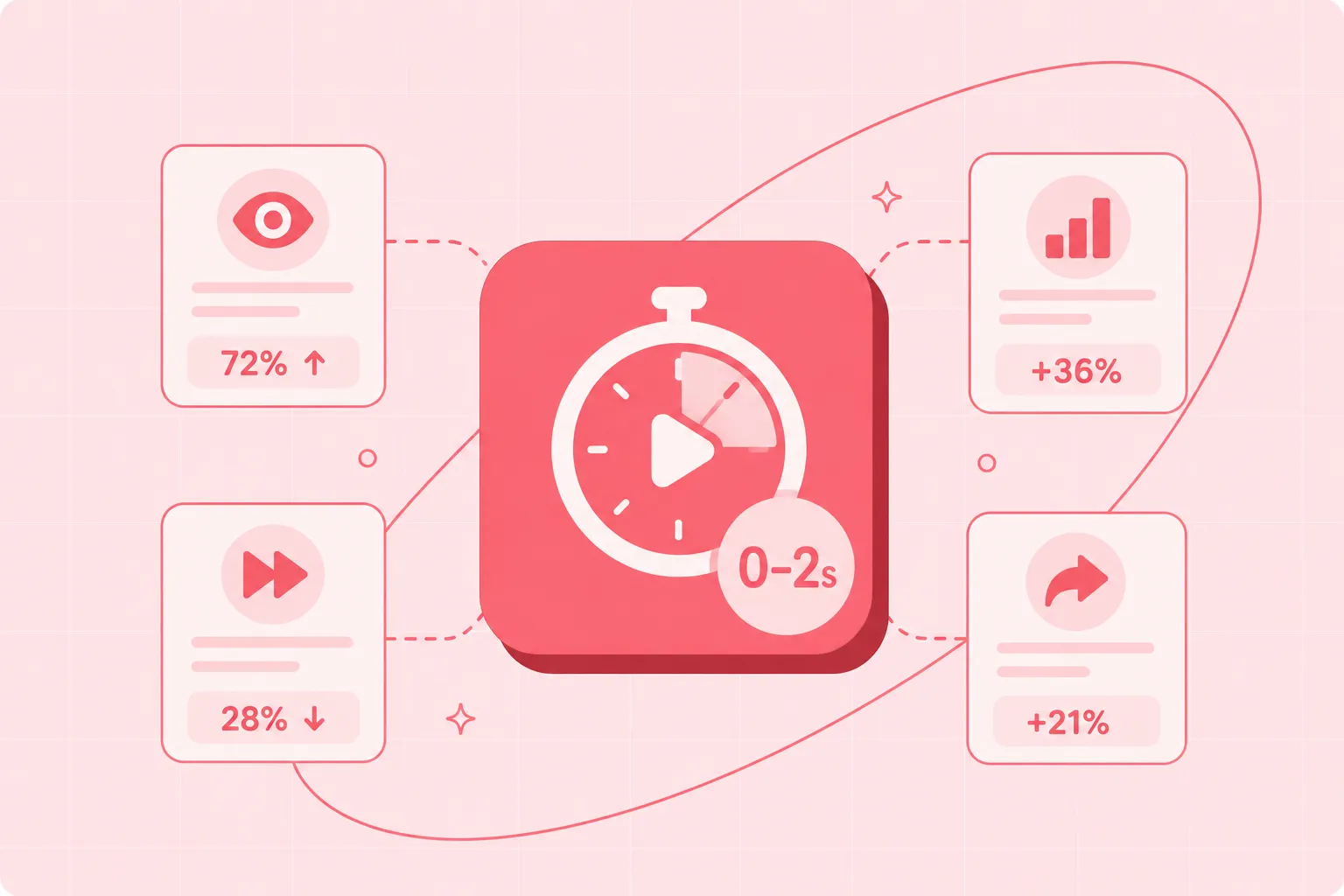
You opened a reel. Two seconds later you swiped up. Instagram wrote that down. The platform calls it a skip. It counts how many times your reel got skipped within two seconds of being opened. That count feeds a guess. The guess: will the next person watch.
This is not guru advice. It is a named signal in the Reels Chaining system card. The card is a page Meta puts out. It explains how one part of Instagram picks what to show you. We read it on 18 Aug 2026. The signal sits under a guess the software makes. The guess: how likely you are to watch less than three seconds.
So the hook is not a figure of speech. It is the thing Instagram counts at the start. Two seconds is the line. You either held a person past it or you did not. This post tells what that signal is. Where it sits in the ranking. And what the studies on early focus say.
Reels are one of three formats you can post. How reels stack up next to carousels and static posts is a separate question. This post stays inside the reel, at the two-second mark. Every source below is linked, dated and quoted. One part reports a finding that cuts against the common advice.
Instagram names the two-second skip in its system card
Meta puts out a page for Reels Chaining. Chaining is the stream of reels that keeps coming once you open one. The page is called a system card. It tells what the ranking software does. What it guesses. What facts it reads. How it cuts the list.
The card was last changed on 11 Nov 2025. We read it in a browser on 18 Aug 2026. It names about 100 reels pulled by a cheap model. About 100 scored and ranked. One model guesses many things at once for a person. The card lists nine guesses. One is the skip:
How likely you are to watch less than three seconds of a reel — Meta Transparency Center, Instagram Reels Chaining AI system card, updated 11 November 2025
That guess runs on signals. Signals are facts the software can read. The card names four. Two count what folks did with the reel. One reads your own past. The fourth is the line to hold:
How many times the post has been skipped within two seconds of being opened — Meta Transparency Center, Instagram Reels Chaining AI system card, updated 11 November 2025
That is a count. A count of skips at two seconds. The signal is real. It is not the only one. But it is put down. It is counted. And it feeds a guess that has a size. Meta does not print the size. Not for this signal. Not for any signal on any part. Every claim on which one wins is not proven. Ours too.
The same card names a second early line. One more signal under the same guess reads "How many times the reel was dismissed". And a past watch signal names "The authors of reels you've spent less than three seconds watching". Three seconds comes up twice. Two seconds once. Both are counted. Both sit in the same bundle of facts that guess an early exit.
So when a person tells you the first few seconds matter, they say what Instagram puts out. The odd part is that most folks saying it have not read the card.
The skip is one input to one guess, not a kill
The two-second skip does not kill a reel. It is one fact among many. The guess it feeds is one guess among nine. All nine get mixed into one score. That score picks the order. Meta's 2023 post on Explore names the shape. Guessed odds. A size on each. Some added. Some taken.
The Reels card gives no formula. It names guesses. Not how they mix. So treat the skip as a pointer. It is a counted bad signal. How much it moves the score is not put down.
Two other guesses on the card also point the wrong way. One guesses how likely you are to click "Interested" if the choices show up. The other guesses how likely you are to follow the writer. Seven good guesses. Two bad. Those two check an early exit and a throw-away. The rest check a deeper act. Reshare. Comment. Use the audio. Watch longer than 95% of users who saw reels the same length.
Treat this as a building fact. The software is built to guess both ways. What you might do. What you might not. A score that only counted likes would rank in a new way than a score that also counts skips. Meta's own note in the Explore post calls user acts "often the most strong". That has the bad ones too.
The honest limit: we know the signal is real. We know it feeds a guess on early exits. We do not know its size. We do not know how much a high skip rate moves the final score. Meta puts out the guesses. It does not put out their size.
What focus research says on the first seconds
The two-second line is Instagram's. The research on early clip focus does not land on the same number. But it does show that the first seconds pick if a person keeps watching.
A 2022 paper put sensors on 50 folks. They watched charity clips. They could stop any time. The sensors tracked a signal the writers call Immersion. It mixes focus and feeling. The finding: clips that got money were watched longer. And the time spent came from peaks of that signal. The writers call it speed-up.
That paper is not on short clips. The mean watch time was 146 seconds. Folks chose to watch. They were not swiping through a feed. But it shows a thing that moves over. Kept watching came from peaks hit while watching. Not from a choice made before the clip began.
Here is the line from the writers:
Acceleration motivated participants to watch the video — Lin, Narender and Zak, Frontiers in Behavioral Neuroscience, 13 Dec 2022
The path runs the other way too. A 2024 paper tested focus tasks in 48 folks. The more they used short clips, the worse their control scored. Control is the part of focus that lets you stay on one thing. It works when other things pull at you. The paper checked brain acts in a task. The link was real. More short clip use matched lower brain power in the front part. This was in tasks needing control.
That paper is a snapshot. It cannot prove that short clips caused the effect. The writers say so. But it shows a link. A link from short clip use to a loss of focus control.
A 2023 paper tested 1,047 students. Short clip habit led to worse focus control. The path ran through steps. Habit made control worse. Worse control raised putting things off. The writers call short clips "fast and rapid switch". That form, they say, can mess with long-term focus control.
None of these papers check what takes place at two seconds flat. But all three point the same way. Early signs tell if a person keeps watching. Seeing fast switch often links to worse focus. And the thing that keeps folks watching builds while they watch. It does not exist before they start.
The hard finding: no one has tested this on Instagram's real ranking
No test we could find shows that a strong hook at two seconds makes Instagram's ranking software show the reel to more folks. The common advice says the hook picks all of it. No test proves it works the way folks say it does.
The signal is real. Instagram puts it down. The first seconds matter because Instagram counts them. But here is what we do not know. Does a reel that holds folks past two seconds get more reach than one that does not? That is not proven by test. The size of any such effect is not put down. Its shape is not put down. And every claim you hear on how much the hook moves the number is a guess dressed as facts.
Two things follow. The way is likely. The costly model can read what folks did. A reel with watch time beats a reel with none. Meta itself calls user acts "often the most strong". But that is our reading of Meta's pages. It is not a finding they put out.
On the other side, we do not know the size. We do not know if the effect grows or stops. We do not even know if the signal matters more than others in the same bundle. The card names four signals under one guess. It does not rank them.
So a person quotes you a rule on the first two seconds. Ask them for the test. Ask us for it too.
What the two-second skip really tells you
The skip signal is a counted fact. It sits inside a guess on early exits. That guess sits inside a score. The score picks the order for one person. Then Instagram builds a new score for the next person. With a new pile of reels. And a new set of guesses on what that person wants.
Your reel is never in one contest. It is scored one by one for each person who might see it. One skip from one person moves one score. It does not kill the reel. And it does not tell you what the other 99 reels in that person's pile got.
Treat the two-second line as a clue. If folks are swiping away at two seconds, they are swiping away. Instagram is counting that. The count feeds a guess that has a size. You do not know the size. But you know the way it points.
The hook is not guru lore. It is a put-down signal. What it does to the final score is not put down. But what it checks is. It checks if you held a person past the first two seconds. The software reads that. It uses that. The papers on focus say the first seconds pick if a person keeps watching.
So when you open a reel and you lose a person at two seconds, Instagram wrote it down. The skip went into a count. The count fed a guess. The guess had a size. And the size moved a score. How much it moved is the part no one can show you. That the skip took place is the part Meta prints in its own card.
What we could not work out
The size of the skip signal. Meta puts out the guesses and the signals. It puts out no size for any of them. Not for the two-second skip. Not for any signal on any part. Every claim on how much the skip moves the score is not proven.
If the effect grows or stops. The focus research shows early signs matter. It does not show how that moves into Instagram's scoring model. The shape of the curve is not put down.
The rank of the skip next to the other three signals under the same guess. The card lists four signals that feed the guess on watching less than three seconds. It does not rank them. So we do not know if the two-second skip counts more than the throw-away count or less.
If a reel with a strong hook gets more total reach. The signal is real. The guess is real. We do not have a test showing that a reel scored high on this guess goes to more folks in all. The way is likely. The proof is not there.
How the 2025 change to the card moved the signals. The card is stamped 11 Nov 2025. We do not have an old saved copy to check. So we cannot say which signals were added, dropped, or changed words since the card was first put out.
How we did this
Scope: this post reads pages that were put out. We opened the Meta page for Reels Chaining in a browser on 18 Aug 2026. The page is built by code in the browser, so pulling the URL gives an empty shell. Each quote was copied off the page as a reader sees it. We also read the 2023 post from Meta on Explore for the scoring formula. And we read four papers on focus and short clips. Each source was opened straight and quoted word for word.
Limits: the system card is a write-up Meta chose to put out. Not a checked report. Meta rewrites these cards without saying when. So each quote here has the card's "last changed" stamp. The papers we cite check focus effects and early watch signs. None of them ran on Instagram. None of them tested Instagram's real ranking software. We report the signal as put down. We report the papers as put out. We do not claim the papers prove things on Instagram's scoring model.
Sources
- Instagram Reels Chaining AI system card, stamped UPDATED NOV 11, 2025. Meta page. Source of the two-second skip signal, quoted as "How many times the post has been skipped within two seconds of being opened" under the guess "How likely you are to watch less than three seconds of a reel". Also the source of the throw-away count and the three-second watch history signal. Built by code in browser, so it gives an empty shell to a fetch tool and was read in a browser. Got 18 Aug 2026.
- Vladislav Vorotilov and Ilnur Shugaepov, Scaling the Instagram Explore recommendations system, 9 Aug 2023. Meta post. Source of the scoring formula telling how guesses get sized and mixed, with the P(see less) term taken. Also the source of the "often the most strong" line on user acts. Got 18 Aug 2026.
- Li-Hsin Lin, Rainita Narender and Paul J. Zak, Why people keep watching: neurophysiologic immersion during video consumption increases viewing time and influences behavior. Frontiers in Behavioral Neuroscience 16:1053053, 13 Dec 2022, doi:10.3389/fnbeh.2022.1053053. Random showing of 11 charity clips to 50 folks (after cuts; 46% female, mean age 28.01 years) with free choice to stop anytime. Brain signal tracked via PPG sensors. Mean watch time 146 seconds (SD=92), ranging from 9 to 444 seconds. The quoted finding is that speed-up, defined as peaks of the signal above a line, told if folks kept watching and gave money. Writers' stated limits: modest number of clips, clips focused on social topics, and a fairly same-type group. Full text read at PubMed Central. Got 18 Aug 2026.
- Tingting Yan, Conghui Su, Weichen Xue, Yuzheng Hu and Hui Zhou, Mobile phone short video use negatively impacts attention functions: an EEG study. Frontiers in Human Neuroscience 18:1383913, 27 Jun 2024, doi:10.3389/fnhum.2024.1383913. 48 folks (35 females, 13 males; mean age 21.8 years). EEG noted in a focus test checking alert, aim, and control. Time study focused on theta band acts. The finding: a real bad link (r = −0.395, p = 0.007) with short clip habit scores and theta power showing control in the front brain region. Writers' stated limits: snapshot design stops proving cause, sample limits with gender gap, task being too simple, and few brain scans. Full text read at PubMed Central. Got 18 Aug 2026.
- Jin Xie, Xinyu Xu, Yamei Zhang, Yuxin Tan, Dazhou Wu, Mingjian Shi and Hai Huang, The effect of short-form video addiction on undergraduates' academic procrastination: a moderated mediation model. Frontiers in Psychology 14:1298361, 15 Dec 2023, doi:10.3389/fpsyg.2023.1298361. 1,047 students (593 male, 454 female; ages 17-25, M = 20.08) from seven schools in central China. Path study using PROCESS tool. The finding: short clip habit badly told focus control (β = −0.23, p < 0.001), with focus control partly in the path from habit to putting things off. Writers' stated limits: snapshot design, easy sampling, sample set to students, did not check bent links. Full text read at PubMed Central. Got 18 Aug 2026.
Changelog
- 2026-08-18: First version drafted.
Read next
 Formats & Craft12 min readWatch time is not one number — the system cards define it eight waysAdam Mosseri calls watch time a top-three ranking signal. Meta's own system cards define it at least eight different ways, across three surfaces, with no published weights. The metric everyone optimizes for is not a single metric.
 Formats & Craft12 min readWatch-time optimization rewired what gets madeWhen platforms started ranking by retention, content changed. The two-second hook. The split-screen sludge. The ban on slow starts. This is how one ranking signal reshaped the grammar of short video, and what the research says it cost.
 Formats & Craft11 min readThe cover is the real hook: thumbnail and first-slide scienceBefore your video plays, one image decides whether anyone clicks. YouTube publishes the numbers, and its own testing tool optimises for something other than the click.