Watch-time optimization rewired what gets made
When platforms started ranking by retention, content changed. The two-second hook. The split-screen sludge. The ban on slow starts. This is how one ranking signal reshaped the grammar of short video, and what the research says it cost.
You spend three hours on a video. You write it, shoot it, edit it. The first frame is you at a desk, about to explain something. You post it. Four hours later it has 200 views. The one before it did thousands.
So you go looking. Someone tells you the algorithm checks the first three seconds. If people skip, you are done. Everyone knows this. It is in hundreds of posts. So you go back. You cut the setup. You open on motion. You try again.
What happened is not about one video. It is about all of them. Watch time became a ranking signal. Then the signal changed what got made.
Here is what we read. We read the pages where Instagram, TikTok and YouTube describe how their systems decide what to show. We read the engineering posts where they explain the models. We read the research on attention and video. Instagram scores each format on its own bundle of predictions, and for video several of those predictions are about time. This post is about what the format did in response. Every source below is linked, dated and quoted.
The signal is real. It is documented
Start with what the platforms wrote. Not what someone said they wrote. What they wrote.
Instagram's Reels system uses watch time. The system card for Reels Chaining was updated 11 November 2025. It lists what the models try to guess. One of those guesses: "How likely you are to watch less than three seconds of a reel." The signal feeding that guess is blunt. The card's words: "How many times the post has been skipped within two seconds of being opened."
Two seconds. That is the window the system measures.
The card lists other time-based signals too. Whether you have been viewing reels for more than 15 seconds. How likely you are to watch more of a reel than 95% of users. How much time people have spent viewing the reel. All of them count. The shortest one is two seconds.
TikTok publishes the same thing. Their newsroom post of 18 June 2020 describes how videos get ranked. One sentence names the top signal. Quote: "A strong indicator of interest, such as whether a user finishes watching a longer video from beginning to end, would receive greater weight." Completion. Beginning to end. That is what the system reads as interest.
YouTube says it too. Their support page describes how ranking works. The sentence is plain: "Our systems use both avg. view duration and avg. % viewed as signals to inform ranking." Two measures. How long you watched. What share of the video you watched. Both are ranking signals.
So the claim is not folklore. The platforms document it. Watch time matters. Completion matters. Skipping early matters. Those are the signals.
Then creators rewired the format
The documented signal is one thing. What creators did with it is another.
Go looking for advice on making a video now. Every guide opens on the same number. Three seconds. The first three seconds decide everything. A search for creator advice on hooks in 2023 to 2025 returns hundreds of posts. All of them say the same thing. If the viewer scrolls past in three seconds, the platform buries your video.
That window shows up as a rule. One analysis of TikTok hook formulas calls the three-second hold "your audition for broader distribution." Another calls it a binary filter. Hold past three seconds. The platform tests you with more people. Lose them before that. You are done.
The format adapted. Videos now open with the answer. Not the question. Not the setup. The answer. What used to build over 30 seconds now lands in the first frame. One creator changed four seconds at the start of a video. Same content after that. The new version got 40 times more views than the old one. Four seconds. That is the entire difference.
The structure inverted. Conclusions moved to the front. Context moved to the back. Or disappeared. The old format: here is the question, here is the answer. The new format: here is the answer. If you stay I will tell you why. The hook is no longer the promise. It is the punchline.
Sludge is the format optimizing for the signal
The next step was not subtle. If retention is the goal, run two videos at once. Keep them watching one while the other plays.
The format has a name. Sludge content. It is a split-screen video. One video plays in the top half. A different video plays in the bottom half. They are not related. The top might be someone talking. The bottom is often Subway Surfers gameplay. Or Family Guy clips. Or ASMR. Something that moves.
Wikipedia defines it this way: content that "combines multiple clips/videos that play simultaneously on a single screen." The term reflects what it does. It dumps two streams of stimulus on the viewer at once. Some versions run three or four. One screen. Four unrelated videos.
It works, in the narrow sense. It keeps people watching. Two researchers tested it. Gopal Chandra Mahakud and Apeksha Thapliyal ran an experiment. They published it in Annals of Neurosciences on 17 March 2026. Their paper divided 48 people into groups. One group watched sludge content. One watched regular short videos. One watched nothing.
Then they tested attention. The sludge group did worst. The paper states: "sludge content viewing led to the greatest decline in scores from pre-test to post-test on the sustained attention task." The statistical result: p < .001. That means a result this large by chance is unlikely. Working memory showed no effect. Sustained attention dropped.
Sample size: 48. That is small. The test ran for 10 minutes. That is short. The authors do not state a formal limitation section. But the numbers limit what the finding can claim. This is one measure, one task, one sitting. It says nothing about long-term effects. It says sludge content hurt attention right after viewing.
So the format that retention signals created has a cost. A measured one.
What the eight-second attention span claim actually is
That brings up the other claim. Human attention spans dropped to eight seconds. Less than a goldfish. You have heard it. It gets cited as the reason for all of this.
It is not true. There is no study behind it.
The claim came from a 2015 report by Microsoft Canada. It said attention span fell from 12 seconds in 2000 to 8 seconds in 2015. It cited a website called Statistic Brain. Researchers went looking for the study. They found nothing. No method. No sample. No paper. Statistic Brain was known for posting unverified numbers with no source.
Microsoft's report was not peer-reviewed research. It was a 52-page marketing document. When researchers tried to trace the eight-second figure, it led nowhere.
Two psychologists who study attention said so plainly. Edward Vogel is a professor at the University of Chicago. His words: "I've been measuring college students for the past 20 years. It's been remarkably stable across decades." Michael Posner identified brain networks for attention. He said: "There is no real evidence that it's changed since it was first reported in the late 1800s."
A 2023 study in Frontiers in Cognition measured attention span across 262 people aged 7 to 85. They used a continuous performance task. The study defined attention span as "the maximum amount of time that a participant continuously maintained an optimal 'in the zone' sustained attention state." Children: 29.61 seconds. Young adults: 76.24 seconds. Older adults: 67.01 seconds. The study says nothing about social media. It measured age. Not media use.
So the goldfish claim has no basis. Human attention has not collapsed. What changed is not the viewer. It is the format. The format changed because the signal changed.
The signal came first. The format followed
Go back to the order. Platforms picked retention as a ranking signal. They documented it. Instagram names two-second skips. TikTok weights completion heavily. YouTube ranks on average view duration.
Then creators adapted. They cut openings. They front-loaded answers. They ran split screens. Every change points at the signal. Hold the viewer. That is the goal the system set. The format is the response.
One number makes this visible. TikTok advised advertisers to use 21 to 34 seconds for in-feed ads. That is the only official length guidance TikTok ever published. It is not about organic posts. But creators read it as a target anyway. Because shorter videos can be watched to completion. Completion is the signal that matters.
The average TikTok length moved. It was 25 seconds in 2022. It is 42 seconds in 2026. Creators are making longer videos. But they still open like short ones. The hook is still in the first three seconds. What changed is the tail. More content after the hook. The structure stayed the same.
YouTube changed how Shorts are counted. A view now registers as soon as the video starts playing. No minimum watch time. That makes the swipe-away rate visible. The platform measures how often people swipe before finishing. Below 30% is strong. Above 40% and the video is buried. The signal and the benchmark are both public now.
So the format changes are not a mystery. They are a response. The system ranks by retention. The format optimized for retention.
What this does not prove
Here is what we do not have. We do not have an experiment showing that better retention causes more reach on these platforms. We can show the platforms rank by retention. We can show creators changed content to maximize retention. We cannot show the size of the effect.
That gap is worth naming plainly. No published experiment measures how much retention affects reach inside Instagram's ranking. Not a weak experiment. None.
The mechanism is documented. The platforms rank by watch time. What is not documented is the curve. How much does one more second matter? How much does completion matter compared to a like? Instagram publishes the signals. It does not publish the weights. So every claim about which signal dominates is unproven. Including the ones in this post.
Two things sit next to each other. Retention is a documented ranking signal. The size of its effect is not. If someone quotes you a multiplier for retention, ask them for the study. It does not exist.
Vertical is the other format change
The retention changes are one thing. The shape of the video is another.
Vertical video is now the default. TikTok, Instagram Reels and YouTube Shorts all use 9:16. That is 1080 pixels wide by 1920 pixels tall. Portrait. Not landscape. The phone is held upright. The video fills the screen.
This is not just cropping. One study on filmmaking for vertical video describes the shift. A 16:9 frame and a 9:16 frame are opposite orientations. Cropping a 4K horizontal frame to 9:16 keeps about one-third of the original view. You lose two-thirds. So production changed. Cameras now shoot vertical from the start.
People hold phones vertically 94% of the time. Vertical video takes the full screen. Horizontal video takes 30% of the screen in a vertical feed. The format followed the behavior.
The change affects more than framing. It affects composition. A vertical frame is taller than it is wide. So subjects sit in the center. Or the bottom. Wide shots do not work. Close-ups do. The grammar of the shot changed because the canvas changed.
That is separate from retention. But it happened at the same time. Both are responses to the platform. Vertical fits the phone. Retention fits the ranking. The format adapted to both.
What we could not find out
Five things, so no one thinks we checked and stayed quiet.
Any weight in any ranking model. Instagram, TikTok and YouTube all publish signals. None publish weights. We do not know how much each signal matters. We know retention is measured. We do not know how much it is weighted against likes, shares or follows. Every ranking breakdown you see, including this one, is reading the signals without the formula.
The sample size in Muchnik 2013. That paper tested fake up-votes and down-votes on a news site. It is often cited as proof that early engagement compounds. We could not read the full text. It is paywalled. The abstract gives no sample size. So we report that the paper exists. We do not report its numbers.
Whether Instagram's Reels funnel has a fourth step. The 2023 engineering post describes a reshuffle after scoring. The 2025 system card names three steps and stops. We are not claiming the step was removed. We are recording that two Meta documents about the same surface count different numbers of steps.
Any decay curve for watch time. Instagram's Feed card says content is ranked "within 90 days." That is the only published window on a post's age. No half-life. No decay rate. No claim about the first hour mattering more than the tenth. Not in the documents we read.
How long the retention effect lasts. The sludge study measured attention right after viewing. It said nothing about whether the effect persists. One sitting is not a trend. We report what the paper showed. We do not claim more than it measured.
How we did this
Scope: we read published documents. No data collection. No experiment of our own.
Sources: every page was opened directly on 17 August 2026. Quotations were copied off the page as a reader sees it. Not off a summary. Six sources send an empty page first and build the text with code. Those six are Meta's Transparency Center pages and Instagram's Help Center page. All six were read in a browser. The research papers were read as the Sources list describes.
Limits: the Instagram, TikTok and YouTube statements are first-party. Written by the companies we are writing about. A system card is a description they chose to publish. Not an audited account. Meta rewrites these cards without saying when. Every quotation here carries the card's date stamp.
Sources
- Instagram Reels Chaining AI system card, stamped UPDATED NOV 11, 2025. Meta Transparency Center. Retrieved 17 August 2026.
- How TikTok recommends videos #ForYou, 18 June 2020. TikTok Newsroom. Retrieved 17 August 2026.
- About watch time data. YouTube Help. Retrieved 17 August 2026.
- TikTok Hook Formulas That Drive 3-Second Holds. Opus.pro blog. Retrieved 17 August 2026.
- Jennifer Chou, 40x more views from changing 4 seconds of video. Creator Spotlight. Retrieved 17 August 2026.
- Sludge content. Wikipedia. Retrieved 17 August 2026.
- Gopal Chandra Mahakud and Apeksha Thapliyal, Assessing the Impact of Different Social Media Video Content Formats on Sustained Attention and Working Memory. Annals of Neurosciences, 17 March 2026 (online ahead of print). PMID: 41869459. Sample: 48 participants aged 22-25. Method: pre-test/post-test with Continuous Performance Test and 2-Back task. Finding: sludge content viewing produced the greatest decline in sustained attention scores (p < .001). Full text at PubMed Central PMC12999531. Retrieved 17 August 2026.
- 8-Second Attention Spans: Tracking the myth that just won't quit. Medium, Psynamic. Retrieved 17 August 2026.
- Alexander J. Simon et al., Quantifying attention span across the lifespan. Frontiers in Cognition, 2023. Sample: 262 individuals aged 7-85. Method: visual continuous performance task. Finding: attention span peaked in young adults (76.24 seconds) and was shorter in children (29.61 seconds) and older adults (67.01 seconds). Full text. Retrieved 17 August 2026.
- Best TikTok Video Length. Social Rails blog. States TikTok's 21-34 second guidance for in-feed advertising. Retrieved 17 August 2026.
- How long are TikTok videos. Social Insider, 2026. Retrieved 17 August 2026.
- Shorts watched as ads do not count toward YouTube's 20 million view bar. PPC Land. Retrieved 17 August 2026.
- What is a good swipe away rate on YouTube Shorts. MiniTool. Retrieved 17 August 2026.
- Filmmaking Theory for Vertical Video Production. IAFOR, EuroMedia 2019. Retrieved 17 August 2026.
- Why Vertical Video Is Becoming the Default Content Format. Oye Labs. Retrieved 17 August 2026.
Changelog
- 2026-08-18: First version drafted.
Read next
 Formats & Craft13 min readShort-form video: the history, the machine, and where the format goes nextThe line from Vine and Musical.ly to TikTok's For You page. What these systems actually optimize for. And where the format is heading as every platform pushes past 60 seconds.
 Formats & Craft15 min readThe retention curve: how to read the graph the platform hands youYouTube shows you exactly where viewers drop off, second by second. Its own help pages explain what the spikes, dips and comparison line count. That curve is the most honest piece of feedback any platform gives you.
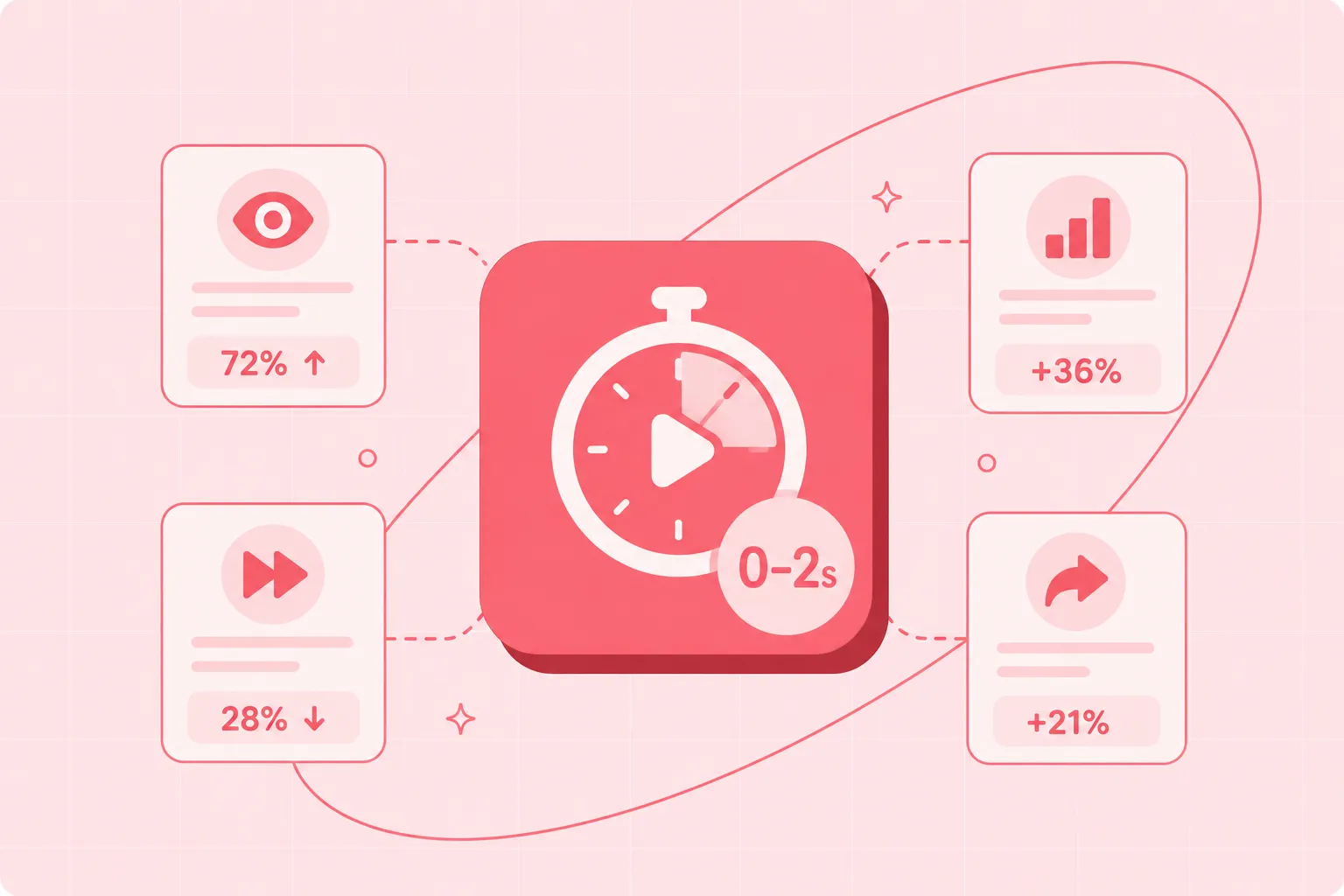 Formats & Craft12 min readThe first two seconds: what the hook does, from Instagram's skip signalInstagram counts how many times a reel was skipped within two seconds of being opened. The signal is named in Meta's own system card, and it feeds a guess about whether the next person will watch.