The feed stopped being your friends — and nobody sent a memo
Meta says a growing share of what you see on Instagram is recommended, not posted by accounts you follow. You are now competing with the entire platform for a stranger's attention.
You check your feed. You scroll past a reel from an account you have never heard of. Then another one. A post about a hobby you looked at once. A meme page. Somewhere in there, a friend.
You did not follow any of those accounts. Instagram chose them. This is not new. What is new is how much of your feed works this way now. And what it means for anyone trying to reach people.
Meta has said it out loud. More than 20 percent of what people see on Instagram is recommended by its software. That content comes from accounts they do not follow. By April 2023 Mark Zuckerberg put a second number on it. Across all of Instagram, about 40 percent of what you see falls into that bucket. That was three years ago. The share has kept growing.
Every source below is linked, dated and quoted.
It used to be a feed of your friends. Now it is a feed for your interests
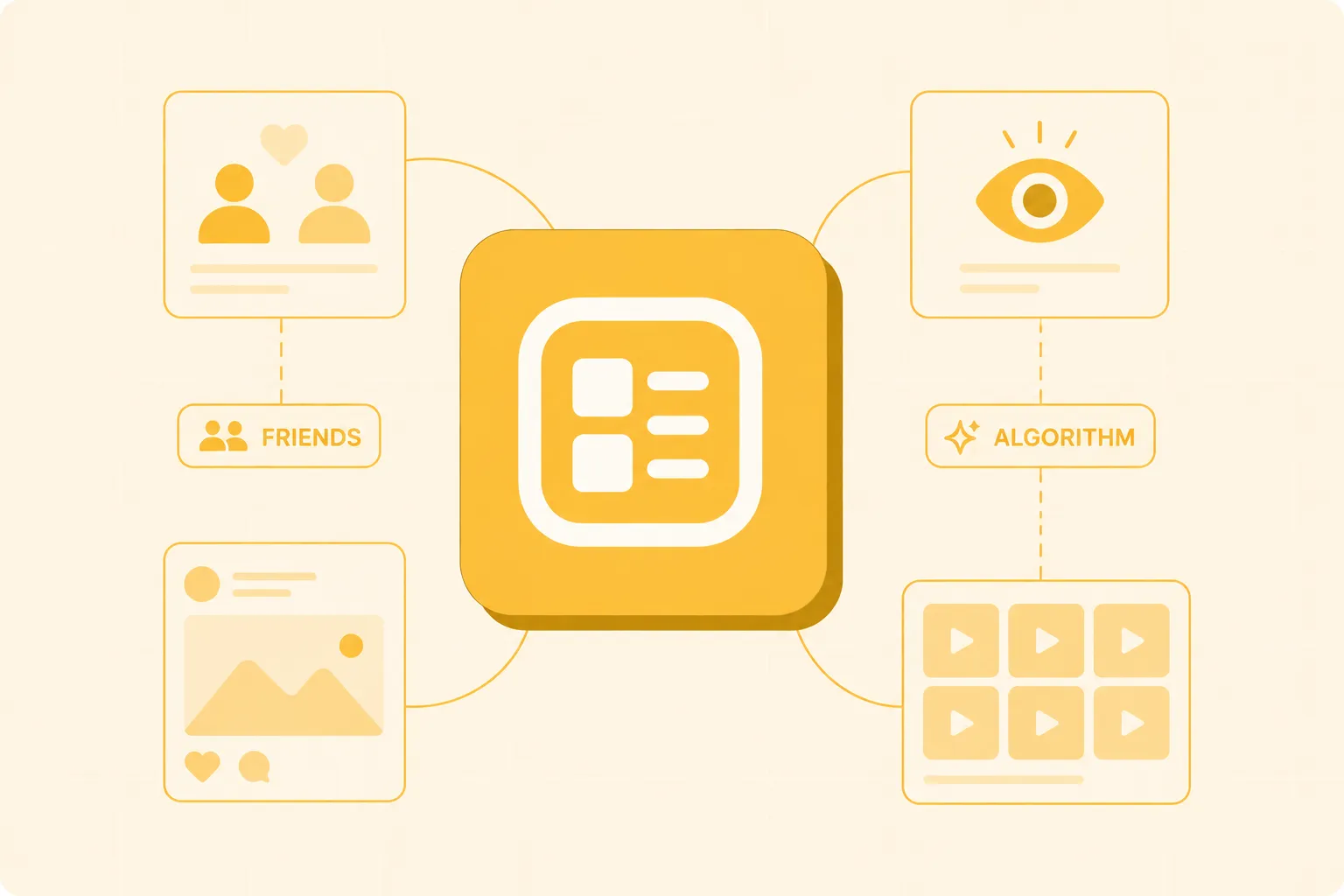
Start with two terms. The people who build these systems use both. A social graph connects people to people. It maps who you follow. An interest graph connects people to topics. It maps what you watch, save and skip.
Instagram started as the first one. You followed accounts. Those accounts showed up. That was the deal. The software that decides what to show you is often called an algorithm. But saying "the algorithm" makes it sound like one thing. It is not. Meta now runs more than a thousand models across Instagram. Each one scores things. A model is software that guesses. It might guess whether you will skip a post. Or watch it twice. Or send it to someone.
The models used to work inside your social graph. They sorted posts from accounts you follow. Now they work inside your interest graph too. They pull posts from accounts you do not follow. And they guess whether you will care. When the guess is about a stranger, there is almost nothing to go on. A post reaching that stranger is a cold item, with no history for the models to read.
Here is how one summary puts it. A social graph algorithm shows you content based on who posted it. An interest graph algorithm shows you content based on how you interact with content like it. Instagram does both now. But the interest graph has become the bigger engine. The friend part did not disappear when the feed stopped carrying it. It moved into messages, where Instagram's ranking documents now count whether you send a post to someone.
Meta calls the two kinds of content by two names. Connected content comes from accounts you follow. Unconnected content comes from accounts you do not. Meta published a page explaining how it recommends unconnected content. That page ran on 29 June 2023. It opens with the number:
more than 20 percent of content in a person's Facebook and Instagram feeds is now recommended by AI from people, groups, or accounts they don't follow — Meta AI blog, The AI behind unconnected content recommendations on Facebook and Instagram, 29 June 2023
Mark Zuckerberg gave a bigger number two months earlier. He was on Meta's earnings call for the first quarter of 2023. That call happened on 26 April 2023. He said more than 20 percent of content in feeds is recommended from accounts you do not follow. Then he gave a second number. Across all of Instagram, about 40 percent of what you see is that kind of content.
We could not read the official earnings call transcript. The PDF is image-based and will not convert. But multiple trade press accounts from April 2023 carry the same two numbers. TheStreet quoted Zuckerberg directly on both.
The 20 percent is the feed specifically. The 40 percent is across the whole app. That includes Reels and Explore. Both of those surfaces show mostly unconnected content. Adam Mosseri runs Instagram. He said so himself in a post dated 31 May 2023. About Explore and Reels, he wrote "the majority of what you see is from accounts you don't follow."
By September 2024 one trade press report said 50 percent of Instagram content is now recommended. That number appeared in Social Media Today. The article cites Benzinga. We could not find a primary Meta statement carrying that exact figure. So we report it as a trade press claim, not as a Meta finding. But the direction is clear. The share keeps rising.
Two separate system cards, two separate contests
Meta publishes pages explaining how each part of Instagram works. Meta calls them system cards. One card covers your feed. Another card covers feed recommendations. Both pages were last updated on 29 June 2026. We read them in a browser on 18 August 2026.
The Feed card describes content from accounts you follow. It says so at the top. The system "ranks posts from accounts you follow." It also says what is not covered. Your feed might include suggested content and ads. That content is not powered by the system the card describes.
The Feed Recommendations card describes the other bucket. Suggested content from accounts you do not follow. It says so in the opening line. The system delivers "suggested content to your feed" from accounts, posts or reels you may be interested in but do not follow. While scrolling your feed you might also see connected content and ads. Those are not powered by the system this card describes.
So Instagram now runs two ranking systems for your feed. One sorts posts from people you follow. One picks posts from people you do not. Both are live at the same time. Both feed the same surface.
That split changes the whole contest. Your post used to compete for space in your followers' feeds. Now it competes in two places. It still goes to your followers. But if Instagram thinks it fits someone's interests, it also goes to strangers. And when it goes to a stranger, it is not competing against their follows. It is competing against everything Instagram thinks that stranger might like. From anyone. Anywhere on the platform.
Turn it around. A stranger's feed used to pull from the few hundred accounts they follow. Now it also pulls from the rest of Instagram. Millions of accounts. Billions of posts. Your post is a candidate in that pile. For every person Instagram thinks might care.
One more number makes this concrete. Meta published a blog post about how it recommends unconnected content. The post is dated 29 June 2023. It describes the scale. The system processes "tens of billions of pieces of content" to find recommendations for nearly three billion users. Every time someone opens the app.
Adam Mosseri explained why Instagram does this. He was interviewed for a Social Media Today article published in March 2024. He said people follow a few hundred accounts. Maybe a few thousand. That gives you 100 or 200 things you could see in a given day. But "there are hundreds of millions of pieces of content posted today that are from accounts you don't follow." Instagram wants to show you some of that. Because keeping you in the app longer is how it makes money.
So the feed stopped being a list of your friends. It became a mix of your friends and the platform's guesses about what you want. The guesses now make up the bigger share.
What the interest graph means for you
Here is what changed. You used to win by getting followers. The more followers you had, the more people saw each post. That was the social graph. You still need followers. But followers do not guarantee reach anymore. Not even close.
Instagram's own help center explains this. Its page on recommendations says only public accounts are eligible. And content must follow higher standards to be recommended than to reach your own followers. Break the recommendation guidelines and your post still goes to your followers. It just will not go to anyone else.
The guidelines list what makes content ineligible. Violence. Regulated products like tobacco. Sexually suggestive content. Political content was added to the restricted list in early 2024. Meta announced in February 2024 that Instagram would stop recommending political content from accounts you do not follow. That covers content about laws, elections or social topics that affect groups of people. Creators can check whether their posts are deemed political in their account status.
The Markup ran an investigation into Instagram's recommendation system. They published it on 25 February 2024. They created 70 test accounts. They posted to custom hashtags. They tracked what appeared and what did not. One finding stands out. Photos of war were 8.5 times more likely to be hidden from hashtag pages than other content. The photos did not show casualties, blood, violence or people in distress. They were hidden anyway.
That tells you the system has opinions. About topics. About content types. About what is safe to recommend. Those opinions are encoded in the models. You do not get to see the weights. You just see the outcome.
The common story about how you break into recommendations is early engagement. Get enough of it fast enough and the models notice. But the platform has never published how much early engagement matters. Or whether it matters at all compared to the content itself. Meta publishes the signals its models read. It does not publish the weights. Every claim about which signal dominates is unproven.
What Meta does say is this. The models guess many things about you. Whether you will like a post. Save it. Skip it. Send it to a friend. Spend time on the poster's profile. All of those guesses feed into one score. Higher scores rank higher. The guesses run on signals. A signal is one fact the model can read. Your past likes. How long you watched. Whether you tapped Not Interested.
Some signals are about the post. Is it a photo or a video. How long is the reel. Is it informative. One signal on the Feed Recommendations card is scored by a large language model. The card calls it "How informative a post is." The whole list of inputs is one sentence. "This signal is purely generated by LLM to assess the post's content quality." An AI reads your post and decides if it is informative. That score goes into the ranking.
Other signals are about what people already did with the post. How many watched it. How many skipped it. How many saved it. A brand new post has none of that. No one has done anything with it yet. That is a problem the people who build these systems call cold start. Scoring something when it has no history.
On the interest graph, you are always cold starting. Every stranger who might see your post is seeing it for the first time. Your post has no history with them. You have no history with them. The models have to guess from the content itself and from how it performed with other strangers.
That is the quiet enormous shift. You are no longer just competing for your followers' feeds. You are competing with the entire platform. For every stranger Instagram thinks might care. And you are doing it with a cold post every time.
The one test Instagram gives you
Instagram offers one product that makes this visible. Trial reels. Instagram announced them on 10 December 2024. The announcement described them in one sentence. "Trial reels will be shown to non-followers first."
Here is who can run one. Public accounts only. A professional account needs at least 200 followers. A personal account needs at least 1,000. Instagram's help center page lists the rules.
A trial reel goes to people who do not follow you. That is what normally happens anyway. The difference is your followers do not see it first. Some followers may still see it elsewhere. If someone shares it in a message. Or on a page that shows reels with the same audio. So it is not a controlled experiment. It is a controlled showing.
You get your numbers about 24 hours after you share. Instagram may push the reel to your followers as well if it performs. That is Instagram's call, not yours. The setting carries forward to future trial reels until you change it.
The December 2024 announcement gave a clock. If Instagram determines the reel is performing well based on views it receives within the first 72 hours, it may share it more broadly. The help center describes the same thing today. But it gives no clock. It says Instagram shares the reel "if it's performing well soon after you publish it, based on signals like views and engagement." Two Meta pages. Two wordings. Only the older one carries a number. We report both.
Instagram also said trial reels "are evaluated independently in Instagram's ranking and don't impact the performance or ranking of your standard reels content." That is a promise about ranking. It is not a promise about reach. The help center names one cost. A trial reel may take longer to get views. Because it is being shown to people who do not follow you.
There is one penalty stated outright. A trial reel "may get limited reach if Instagram detects that you've previously shared the same content." Mosseri's 2023 ranking post named reels already posted on Instagram as something the company aims to show less of. So testing something you published before means testing a handicapped copy.
Treat trial reels as a measuring tool. What you get is one reel's showing against a mostly unconnected audience. On a clock Instagram published. Without spending your followers to find out. What you do not get is the score. Or the weights behind it. Or any comparison with anyone else's reel.
What we could not determine
Five things. Named so no one assumes we checked them and stayed quiet.
Where the 50 percent figure came from. Multiple trade press articles from mid-2024 cite it. One says Adam Mosseri stated it in April 2024. We could not find a primary Meta document or a first-party statement carrying that exact number. So we report it as a trade press claim. Not as a Meta finding.
Any weight in any ranking model. Meta publishes what its models guess. It publishes the signals they read. It does not publish the weight on any signal. Not on any surface. Not in any document we read. Every claim about which signal dominates is unproven. That includes every reading in this post.
How early engagement affects recommendations. Meta says interaction features are "usually the most powerful." That is from its 9 August 2023 engineering blog about Explore. But the sentence is about the expensive ranking step. Not about the cheap sweep. And it gives no number. No decay curve. No threshold. So the size of any effect is unknown.
Whether the interest graph treats all content types equally. The Markup found war photos hidden at 8.5 times the rate of other content. Instagram's guidelines say some topics are ineligible for recommendations. But the guidelines do not give weights by topic. Or by format. So which kinds of content the system prefers is partly documented and partly opaque.
What the LLM informativeness score actually measures. The Feed Recommendations card says one score is "purely generated by LLM to assess the post's content quality." It does not say which model. It does not say what prompt. It does not say how that score trades off against engagement signals. So a major input to whether unconnected people see your post is a black box with a one-line description.
What this means for how you should post
Go back to where this started. You check your feed. You scroll past accounts you never followed. They are there because Instagram guessed you would care. Whether the guess was right does not change the mechanism. The feed is no longer your friends. It is your interests. As Instagram reads them.
For you, the person posting, that means something specific. Your followers are still your followers. They may still see your posts. But reaching them is the smaller game now. The bigger game is reaching strangers. And reaching strangers means winning two contests at once.
First, your content has to fit Instagram's rules for what is safe to recommend. No violence. No regulated products. No sexually suggestive material. Not too political. The guidelines draw those lines. The Markup showed the system enforces them unevenly. War photos that broke no stated rule were hidden anyway. You are guessing at a moving target.
Second, your content has to beat the interest graph's cold start problem. A stranger's feed used to pull from a few hundred accounts they follow. Now it pulls from the whole platform. Your post is competing against millions of other posts. With no history. No past engagement. Just the content itself and whatever Instagram's models can read from it.
Nobody told you the contest changed. Instagram did not send a memo. It published system cards and blog posts and help center pages. It updated them without saying when. The shift happened in stages. Fifteen percent recommended content in 2022. More than twenty percent by 2023. Forty percent across all of Instagram by April 2023. Maybe fifty percent by 2024. The numbers come from earnings calls and trade press and one carefully worded blog post. You had to be watching to notice.
What you can do with this is smaller than what you cannot. You cannot see the weights. You cannot see the score on your post. You cannot see why one post reached strangers and another did not. Trial reels give you one glimpse. They show you your reel's performance with non-followers on a clock. That is more visibility than you get on a standard post. But it is still not the why.
What you can do is stop assuming your followers will see your posts. And stop assuming that reaching people is about getting more followers. It used to be. It is not anymore. The follower count is one input. The content is another. Which one matters more is unpublished. The only certainty is this. The feed stopped being your friends. And the game is no longer played inside your follow list. It is played across the entire platform. For every stranger who might scroll past.
How we did this
Scope: this post reads published documents and trade press reports. No data collection. No experiment.
How we read them: each Meta source was opened directly on 18 August 2026. The two system cards and the Meta AI blog post were read in a browser. The Instagram help center page was read in a browser. Those pages are built by code, so downloading the URL returns an empty shell. Mosseri's 2023 ranking post was read as a finished page. Quotations from Meta are rendered with straight quote marks for consistency. No other character is altered.
Trade press sources: we cite trade press reports to date claims and to report what Zuckerberg said on the Q1 2023 earnings call. We could not read the official transcript. The PDF downloaded but will not convert to text without poppler. Multiple outlets from April and May 2023 carry the same numbers. We treat those as corroborating reports of a public statement. Not as independent primary sources.
The Markup investigation: published 25 February 2024. Methodology section read in full. Sample size: 70 test accounts plus control and observation groups. The 8.5x figure for war photo suppression is quoted as The Markup calculated it.
The interest graph definition: taken from a marketing industry explainer, not from Meta. Meta uses the terms "connected" and "unconnected" in its own writing. The terms "social graph" and "interest graph" are industry terms describing the same split.
Limits: most sources are first-party Meta statements. A system card is a description Meta chose to publish. Not an audited account. Meta rewrites these cards without saying when. Every quotation carries the card's updated stamp from the day we read it.
Sources
- Meta AI blog, The AI behind unconnected content recommendations on Facebook and Instagram, 29 June 2023. Source of the 20 percent figure and the description of how retrieval and ranking work for unconnected content. Retrieved 18 August 2026.
- Instagram Feed AI system card, stamped UPDATED JUN 29, 2026. Meta Transparency Center. Describes ranking for content from accounts you follow. Read in a browser. Retrieved 18 August 2026.
- Instagram Feed Recommendations AI system card, stamped UPDATED JUN 29, 2026. Meta Transparency Center. Describes ranking for suggested content from accounts you do not follow. Source of the LLM informativeness signal. Read in a browser. Retrieved 18 August 2026.
- Adam Mosseri, Instagram Ranking Explained, 31 May 2023. About Instagram. Source of the statement that the majority of what you see in Explore and Reels is from accounts you don't follow. Retrieved 18 August 2026.
- TheStreet, Mark Zuckerberg Reveals a Troubling Change to How Facebook, Instagram Feeds Work, April 2023. Trade press report citing Zuckerberg's Q1 2023 earnings call statement that more than 20% of feed content and about 40% of all Instagram content is AI-recommended from accounts users don't follow. Retrieved 18 August 2026.
- Fortune, Mark Zuckerberg says Instagram will show twice as much A.I.-recommended content, despite Kylie Jenner's protests, 28 July 2022. Reports Zuckerberg's statement that 15% of feed content was AI-recommended in July 2022, with plans to double it by end of 2023. Retrieved 18 August 2026.
- Social Media Today, Instagram Chief Says 'Following' Feed Option Won't Work, 29 September 2024. Reports 50% of Instagram content is AI-recommended, citing Benzinga. Also quotes Mosseri on why following-only feeds result in lower engagement. Retrieved 18 August 2026.
- About Trial Reels on Instagram. Instagram Help Center, undated by the publisher. Source of eligibility requirements, the 200 and 1,000 follower thresholds, and the independent ranking statement. Read in a browser. Retrieved 18 August 2026.
- Instagram for Creators, Trial reels: Try content with non-followers first to see what performs best, 10 December 2024. Source of the "shown to non-followers first" sentence and the 72-hour performance window. Retrieved 18 August 2026.
- Recommendations on Instagram: What Creators Need to Know. Instagram for Creators. Source of recommendation guidelines, eligibility requirements, and best practices. Retrieved 18 August 2026.
- The Markup, How We Investigated Shadowbanning on Instagram, 25 February 2024. Methodology and findings from an investigation into Instagram's content moderation and recommendations. Sample: 70 test accounts. Finding: war photos 8.5 times more likely to be hidden from hashtag pages. Retrieved 18 August 2026.
- The Shelf, The Interest Graph vs the Social Graph. Industry explainer defining social graph (prioritizes content from followed accounts) and interest graph (prioritizes content based on user behavior and interests). Retrieved 18 August 2026.
- Engineering at Meta, Scaling the Instagram Explore recommendations system, 9 August 2023. Source of the statement that user-item interaction features are "usually the most powerful" but cannot be used in the cheap retrieval step. Retrieved 18 August 2026.
Changelog
- 2026-08-18: First version drafted.
Read next
 Distribution21 min readStories is not Feed, and almost nobody researches itEvery guide is about Reels and Feed. Stories runs on a different system with different signals, and it is the one surface built to reach people who already follow you.
 Distribution12 min readThe ad auction has a public formula — and organic reach runs on its twinMeta publishes exactly how it picks which ad wins. The middle term is the same prediction that decides organic reach. Read the ad mechanics Meta explains openly and you understand the organic ones it does not.
 Distribution16 min readThe thousand-model machine, explained for humansMeta's engineers describe over 1,000 models, two-tower networks, and a funnel that narrows billions of posts to hundreds. Here is what that actually means.