The ad auction has a public formula — and organic reach runs on its twin
Meta publishes exactly how it picks which ad wins. The middle term is the same prediction that decides organic reach. Read the ad mechanics Meta explains openly and you understand the organic ones it does not.
You open Instagram. A post from someone you follow shows up third in your feed. Not first. Not tenth. Third. Why that spot? The app will not tell you.
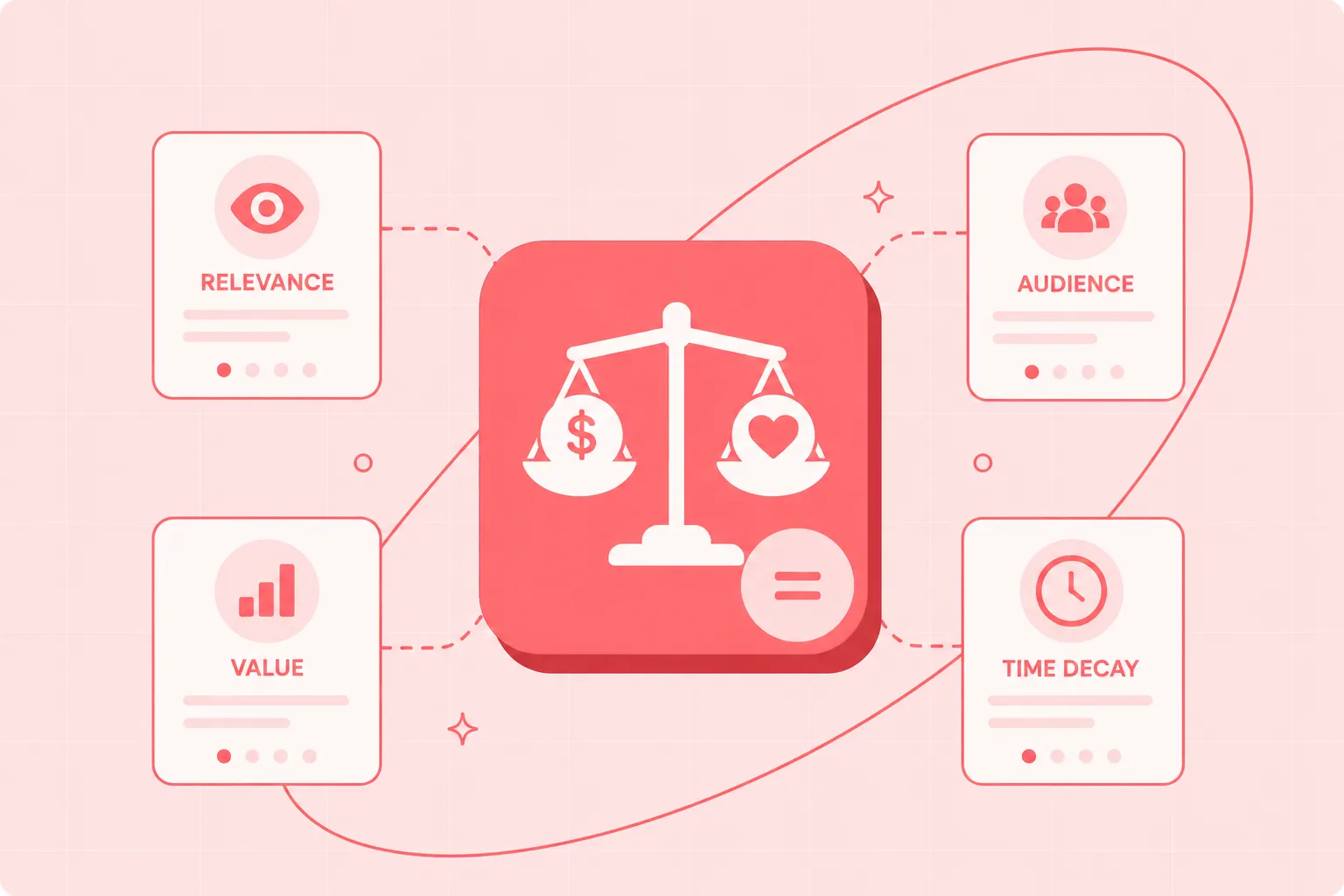
But Meta will tell you how it picks an ad for that same spot. It publishes the formula. Bid times estimated action rate times ad quality. The winner is not the highest bidder. It is the highest total value. And right there in the middle sits a guess. Will you act?
That guess is not just for ads. It is how the whole system works.
Meta makes the same prediction for every organic post. Will you like it. Will you skip it. Will you save it. Then it adds the guesses up. Posts with higher scores show up higher. A post you just published gives those guesses almost nothing to read. Instagram scores it as a cold item. The formula in the ad auction is the skeleton key. It shows you what the organic ranking is doing. Without saying so.
What follows connects the two. The ad side is documented. Meta explains it to advertisers. The organic side is scattered across system cards most people do not read. Put them together and the picture is the same. Both systems guess what you will do. Then they rank by those guesses. One charges money to enter. The other does not. That is the only difference that matters.
Every source below is linked, dated and quoted.
Meta publishes the ad auction formula
Start with the paid side. Meta runs an auction every time someone could see an ad. You want to show your ad. So does everyone else. Meta picks one. Here is how.
The formula appears in many places. Industry sources describe it the same way. Total value equals bid times estimated action rate times ad quality. The ad with the highest total value wins. Not the highest bid. The highest total value.
Three pieces. Take the middle one. Estimated action rate. Meta defines it. From multiple industry descriptions of Meta's official documentation, estimated action rate is the platform's prediction. Will this specific person take the action you want. Click. Buy. Install. Sign up. The guess is per person. Per ad. Made fresh every time.
That is not a bid. It is not your setting. It is Meta's machine guessing about one person looking at one ad at one moment. The auction runs on that guess.
The formula says the rest. Your bid gets multiplied by the guess. A high bid times a low guess loses to a low bid times a high guess. Ad quality is the third term. It measures how much people engage with the ad versus hide it or report it. Quality drops when creative gets stale. That is called fatigue.
So the system does not just pick the ad you paid the most for. It picks the ad people are most likely to act on. Meta's business depends on ads working. If they do not work, advertisers leave. So the auction bakes in a prediction. Will it work on you?
Instagram's organic ranking makes the same guesses
Now the organic side. Instagram Feed does not charge to enter. But it still has to pick what to show you. Meta publishes that process too. Just not in one place.
Adam Mosseri runs Instagram. He wrote about how Feed ranking works on 31 May 2023. The post is called Instagram Ranking Explained. It lists what the system predicts. Five guesses. How likely you are to spend a few seconds on a post. Comment on it. Like it. Share it. Tap on the profile photo.
Those are predictions. Same structure as the ad auction. The system guesses what you will do. Then it ranks by the guesses. The post even says so. In his words: "The more likely you are to take an action, and the more heavily we weigh that action, the higher up in Feed you'll see the post."
Read that twice. Likely you are to take an action. That is estimated action rate. Same term. Same idea. More heavily we weigh that action. That is the formula. Predictions times weights. Add them up. Rank by the total.
Meta's engineers wrote it out. Not for Feed. For Explore. But the shape is the same. Their post is called Scaling the Instagram Explore recommendations system. It was published 9 August 2023. It describes a value model. That is their name for the final scoring formula. And they print it:
Expected Value = W_click * P(click) + W_like * P(like) – W_see_less * P(see less) + etc. — Engineering at Meta, Scaling the Instagram Explore recommendations system, 9 August 2023
That is the organic side's formula. P is short for probability. Probability of a click. Probability of a like. Probability you ask to see less. W is the weight. How much that guess matters. The weights are tunable. Meta does not publish them. But it publishes the formula. Predictions times weights. Add them up.
Now put the two formulas side by side. The ad auction multiplies terms. Bid times estimated action rate times ad quality. Explore adds terms. Weight times probability of click plus weight times probability of like. Different arithmetic. Same structure. Both rank by predictions about you.
Every surface makes its own guesses
Instagram is not one system. Feed is one system. Explore is another. Reels is a third. Meta calls each one a surface. Each surface has its own ranking. Each makes its own list of guesses.
Meta publishes pages for these. They are called system cards. Each card lists what that surface predicts. The cards sit on the Meta Transparency Center. We read four of them. Feed. Explore. Reels Chaining. Feed Recommendations. Chaining is Meta's word for the reels that keep playing after you open one. Feed Recommendations is the system that shows you posts from accounts you do not follow.
Take Explore. Its card lists ten predictions. How likely you are to follow the author. Spend more than five seconds on a post. Watch more than 95% of a video. Click not interested. Comment. Like. Reshare. Click and also engage. Save. Click a short squared post to view it full screen. Ten separate guesses. All about you. All about one post.
Reels makes eight predictions. How likely you are to use the reel's audio. Watch less than three seconds. Click interested. Comment. Watch more than 95% of it. Reshare. Follow the author. Like it. Eight guesses. Per reel. Per person.
Feed Recommendations makes a guess no human writes. One of its predictions is "how informative a post is." The card says where that comes from. In its own words: "This signal is purely generated by LLM to assess the post's content quality." LLM is short for large language model. That is software trained to read and write. An AI is reading your post. Scoring how informative it is. That score goes into the ranking.
The predictions change by surface. But the method does not. Guess what the person will do. Weight the guesses. Add them up. Rank by the total.
The minus sign is the part that matters most
Go back to the Explore formula. One term has a minus sign in front of it. Weight times probability of see less. That gets subtracted.
Most people talk about engagement as one thing. Get more of it. But the formula says otherwise. Some actions count against you. The system guesses how likely you are to hide a post or click not interested. That guess gets a weight. Then it comes off the top.
So you are not just trying to add to a score. You are trying to avoid subtracting from it. A post people skip is not neutral. It is negative. The Explore card lists "how likely you are to click 'Not Interested' on a post" as one of its ten predictions. Feed's card lists "how likely you are to skip this post" as a prediction. Both go into the score. Both push the post down.
Meta's engineering post about Explore says the weights are tuned. One metric gets traded off against another. It says the value model is "our approximation of the value that each media brings to a user." So they are trying to guess how much you want to see something. Not just how much you might click it.
The negative predictions matter because they measure regret. You saw the post. You did not want to. That is a failure on the platform's side. It wasted your time. So it guesses how likely that is. Then it avoids showing you things that score high on that guess.
That is why skips matter. Why hiding posts matters. Why clicking not interested matters. They all feed the same prediction. Will you regret seeing this?
What we could not verify from Meta's own pages
We could not open Meta's official Business Help Center page about the ad auction. The URL returned an error. So we cite the formula from consistent industry descriptions. But we could not quote Meta's own help page directly. Every industry source we checked describes the same three-term formula. Bid times estimated action rate times ad quality. That consistency across sources is why we report it. But a primary Meta page stating it word-for-word is something we tried to find and could not load.
We also cannot show the weights. Meta publishes the predictions. It publishes the formula structure. It does not publish the weights. So every claim about which prediction matters most is unproven. That includes Mosseri's statement that the five he lists are the most important. He says "roughly a dozen" predictions run in Feed. He lists five. Which of the other seven matter? At what weight? That is not published.
The connection between the two systems is our reading. Not Meta's claim. Meta has never written "the organic system works like the ad auction." We are the ones putting them side by side. The formulas are both published. The structure is the same. But Meta has never said that itself.
The theory about early engagement has no published proof
The most common theory about reach goes like this. Early engagement on a post gives it a history. A history gives the expensive models something to read. So the post ranks higher.
That theory is plausible. Meta's own writing says user-item interaction features are "usually the most powerful" signals. That is from the Explore engineering post. A post with likes beats a post with no likes. If the model is reading those counts. And weighting them high.
But no published experiment proves it. Not on Instagram. Not inside Instagram's ranking software. The case for it is an inference from what Meta publishes. Not a finding Meta has stated. So if someone promises you that early engagement lifts reach, ask for the study. It does not exist.
The mechanism makes sense. The size of the effect is unknown. The shape over time is unknown.
Why the ad formula is the skeleton key
The ad auction is easier to explain than organic ranking. Because Meta has to explain it. Advertisers are customers. They pay money. They want to know what they are paying for. So Meta documents it.
Organic reach is free. No one is owed an explanation. So the explanation is scattered. System cards here. Engineering posts there. A blog post from the head of Instagram somewhere else. The formula is in pieces.
But the pieces all say the same thing. The system guesses what you will do. It weights the guesses. It ranks by the weighted sum. That is what the ad auction does too. Openly. In a formula you can write down.
So read the ad mechanics. Then look at the organic system cards. The predictions are there. The weights are not. But the method is. It is the same method. One charges you to enter. The other does not. One explains itself to customers. The other explains itself to researchers. But both run on the same skeleton. Guess what the person will do. Rank by the guess.
That is what estimated action rate means. It is a prediction about one person and one piece of content. Made fresh. Used once. Then thrown away and made again for the next person. The ad auction calls it estimated action rate. The organic system calls it a probability. P of click. P of like. P of see less. Two names. Same thing.
Go back to the post that showed up third. Not first. Not tenth. Third. The system made a guess about you and that post. How likely you were to spend time on it. Like it. Skip it. Save it. It made those same guesses about the posts above it and below it. Then it weighted them. Added them up. Sorted them. That is why it landed there. Not because of when you posted. Not because of what audio you used. Because of what the machine predicted you would do.
Sources
- Adam Mosseri, Instagram Ranking Explained, 31 May 2023. About Instagram. Source of the five key Feed predictions and the quote "The more likely you are to take an action, and the more heavily we weigh that action, the higher up in Feed you'll see the post." Retrieved 18 August 2026.
- Vladislav Vorotilov and Ilnur Shugaepov, Scaling the Instagram Explore recommendations system, 9 August 2023. Engineering at Meta. Source of the value model formula "Expected Value = W_click * P(click) + W_like * P(like) – W_see_less * P(see less) + etc." and the statement that user-item interaction features are "usually the most powerful" signals. Retrieved 18 August 2026.
- Instagram Explore AI system card, stamped UPDATED JUN 22, 2026. Meta Transparency Center. Source of the ten predictions Explore makes. Retrieved 18 August 2026.
- Instagram Feed AI system card, stamped UPDATED JUN 29, 2026. Meta Transparency Center. Source of Feed's prediction "how likely you are to skip this post." Retrieved 18 August 2026.
- Instagram Reels Chaining AI system card, stamped UPDATED NOV 11, 2025. Meta Transparency Center. Source of Reels' eight predictions. Retrieved 18 August 2026.
- Instagram Feed Recommendations AI system card, stamped UPDATED JUN 29, 2026. Meta Transparency Center. Source of the LLM-generated informativeness score, quoted as "This signal is purely generated by LLM to assess the post's content quality." Retrieved 18 August 2026.
- Meta ad auction formula: described consistently across multiple industry sources as Total Value = Bid × Estimated Action Rate × Ad Quality. We attempted to access Meta's official Business Help Center page about the ad auction but the URL returned a 404 error. The formula structure and estimated action rate definition are reported from consistent secondary descriptions, not from Meta's own help page directly.
How we did this
Scope: this post reads published documents and connects two systems Meta describes separately.
How we read them: Instagram system cards were accessed via WebFetch on 18 August 2026. Each quoted sentence was extracted from the live page. The Explore engineering post and Mosseri's ranking post were both accessed the same day. We attempted to access Meta's Business Help Center page about the ad auction at multiple URLs. All returned 404 errors. So we report the ad auction formula from consistent industry descriptions, not from Meta's own help page.
Limits: we are connecting two systems Meta has never connected itself. Meta publishes the ad auction formula. Meta publishes organic ranking predictions. We are the ones saying they work the same way. That is our inference, not Meta's claim. The weights in the value model are not published, so we cannot show which predictions matter most. The ad auction formula is reported from secondary sources because we could not load Meta's primary help page.
Read next
 Distribution16 min readThe thousand-model machine, explained for humansMeta's engineers describe over 1,000 models, two-tower networks, and a funnel that narrows billions of posts to hundreds. Here is what that actually means.
 Distribution13 min readThe minus sign — what Instagram scores against youMeta's 2023 engineering post prints the scoring formula. The "see less" term is subtracted. Every system card lists predictions nobody talks about.
 Distribution18 min readThe feed stopped being your friends — and nobody sent a memoMeta says a growing share of what you see on Instagram is recommended, not posted by accounts you follow. You are now competing with the entire platform for a stranger's attention.