The minus sign — what Instagram scores against you
Meta's 2023 engineering post prints the scoring formula. The "see less" term is subtracted. Every system card lists predictions nobody talks about.
You posted a reel yesterday. It got likes. It got a dozen comments. The engagement looked good. This morning you check the reach. Two thousand views. The one before it did twenty thousand. Same topic. Same format. You cannot see what changed.
So you read another guide. Ten ways to boost reach. Post at this hour. Use these hooks. The advice is always the same. Do more of what Instagram rewards. Get likes. Get saves. Get shares. The whole genre talks about what gets added to your score.
Almost no one has read what gets subtracted.
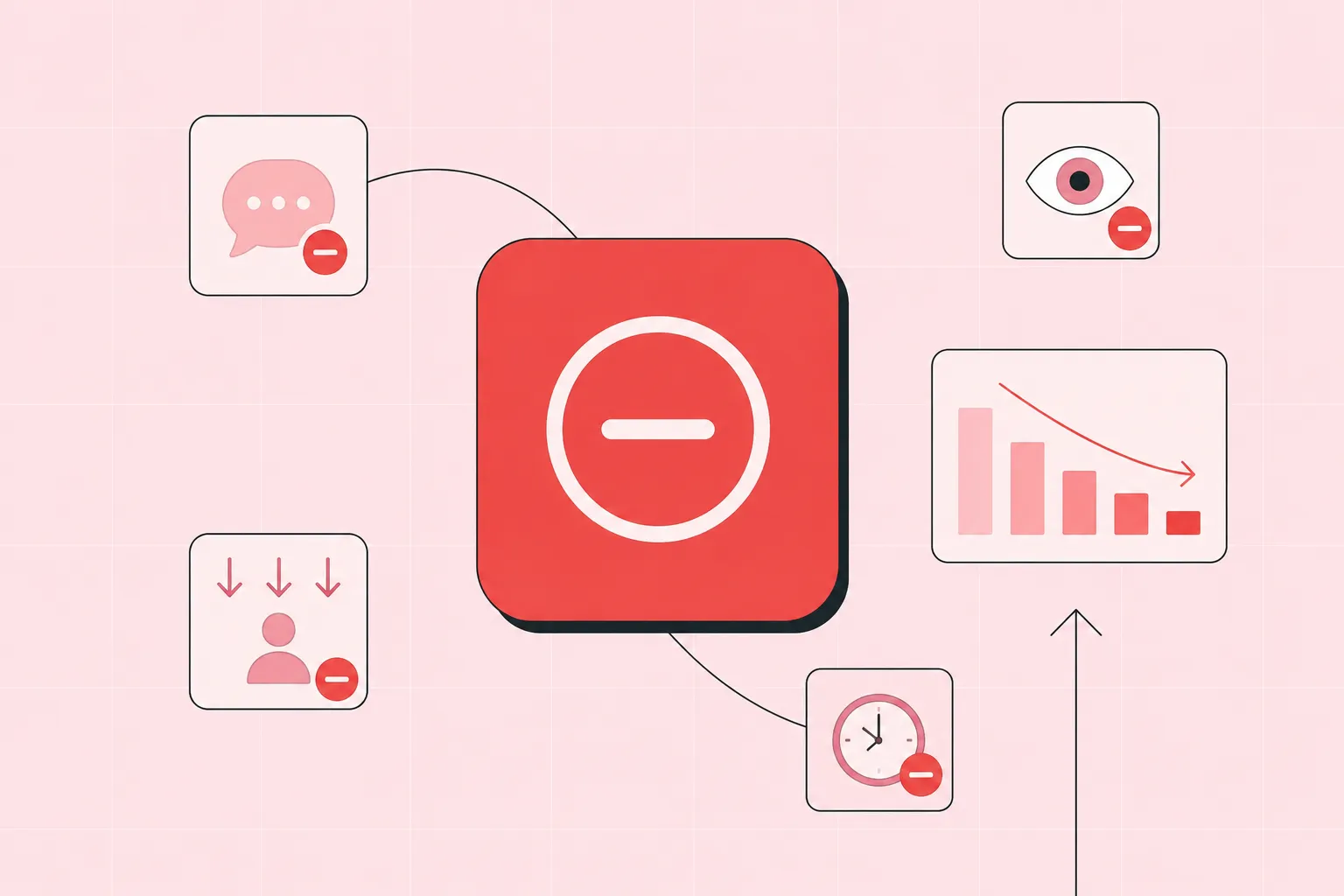
Meta published the formula in 2023. It is in an engineering post about Instagram Explore. The formula has a minus sign in it. The "see less" term comes off your score. And the system cards name predictions creators almost never think about. How likely you are to skip a post. How likely you are to tap "not interested". How likely you are to watch less than three seconds of a reel. Every one of those guesses works against you.
This is not hidden. It is in public documents. Meta prints it on transparency pages that anyone can read. But the Instagram advice industry does not talk about it. They talk about likes and comments. They say engagement is what matters. They do not say there is a part of the score that goes the other way.
We went looking for what Instagram actually scores. Not what people say it scores. What Meta's own engineers wrote. Here is what we found. Every part of Instagram makes guesses about you. Some of those guesses point up. Some point down. And the down ones get subtracted before the sorting happens.
Every source below is linked and quoted.
A brand new post has none of these signals, positive or negative. Instagram ranks it as a cold item. This post is about what the score does once the signals exist.
It is not one score. It is a formula with terms going both ways
Start with the word everyone uses. Engagement. It sounds like one thing. One number going up or down. That is not how the software sees it.
Meta's engineers wrote about Instagram Explore on 9 August 2023. The post is called Scaling the Instagram Explore recommendations system. It explains how Explore decides what to show you. And it prints a formula. This one:
Expected Value = W_click * P(click) + W_like * P(like) – W_see_less * P(see less) + etc. — Engineering at Meta, Scaling the Instagram Explore recommendations system, 9 August 2023
Unpack that. P stands for probability. A guessed chance. The chance you click. The chance you like. The chance you ask to see less. Each one gets a weight. That is the W in front of it. Then they get combined into one number.
Look at the third term. The see-less term. It has a minus sign in front of it. The other terms get added. That one gets taken away.
Meta's own words for what this formula produces: "our approximation of the value that each media brings to a user". Media is their word for a post. So this is the score. And part of the score is subtracted.
The post does not print the weights. Not for Explore. Not for any other part of Instagram. So no one can tell you which term matters most. Every claim about ranking weights is unproven. That includes every claim in this post. What Meta does print is the structure. Add some things. Subtract others. Combine them. That is the value model.
Now the negative term has a name. You can go looking for where it gets fed. The answer is everywhere.
Every system card lists predictions that work against you
Meta puts out a page for each part of Instagram. Each page explains how that part decides what to show you. Meta calls them system cards. There are nine of them under Instagram. One for Feed. One for Explore. One for Reels. One for Stories. Each card lists what the software guesses about you.
The guesses split into two kinds. Things you would choose. And things you would not. Take Feed first. The Feed card was updated 29 June 2026. It lists predictions. Here are two of them:
- How likely you are to spend time on a post.
- How likely you are to skip this post.
The first one is engagement. The second one is the opposite. Both are guesses the model makes. Both feed the score.
The Explore card was updated 22 June 2026. It lists this:
- How likely you are to click "Not Interested" on a post.
The Reels Chaining card was updated 11 November 2025. Chaining is Meta's word for the run of reels that keeps arriving once you open one. That card lists:
- How likely you are to watch less than three seconds of a reel.
And the signals that feed that guess are blunt. One of them, in the card's own words: "How many times the post has been skipped within two seconds of being opened."
The Feed Recommendations card was updated 29 June 2026. It covers posts in your feed from accounts you do not follow. It lists:
- How likely you are to skip over the first post in feed.
Four system cards. Four different parts of Instagram. Every one lists a prediction about you giving up on a post. Here they are side by side, in each card's own words:
- Feed. How likely you are to skip this post.
- Explore. How likely you are to click "Not Interested" on a post.
- Reels Chaining. How likely you are to watch less than three seconds of a reel.
- Feed Recommendations. How likely you are to skip over the first post in feed.
Source: Meta Transparency Center system cards for each surface, retrieved 17 August 2026. The update dates are the ones given above.
That is the list creators do not see. Everyone knows Instagram guesses whether you will like a post. Almost no one knows it also guesses whether you will skip it. Both guesses happen. Both feed the ranking.
The signals that feed the negative predictions
A prediction is a guess. A signal is a fact the guess runs on. The system cards list both. And the signals for negative predictions are just as detailed as the ones for likes.
Take the Reels Chaining card. It lists signals that feed the guess about watching less than three seconds. Here are three of them:
- How many times the reel was dismissed.
- How many times the post has been skipped within two seconds of being opened.
- The authors of reels you've spent less than three seconds watching.
Those are counts. The model reads them. Then it guesses how likely you are to bail in under three seconds. That guess goes into the score.
The Explore card lists signals for the "Not Interested" prediction:
- How many short, squared posts you've clicked not interested in the recent past.
- How many authors you've seen and clicked not interested.
Again, counts. The model reads your history of tapping "not interested". Then it guesses whether you will tap it on this post.
Every surface works the same way. The cards list positive signals. They also list negative ones. The Reels Chaining card, split into the two kinds:
- Positive.
- How many times you've reshared a reel.
- How likely you are to use the audio from a reel you're viewing.
- How likely you are to follow the author of a reel.
- Negative.
- How many times the reel was dismissed.
- How many times the post has been skipped within two seconds of being opened.
- How likely you are to watch less than three seconds of a reel.
Source: Instagram Reels Chaining AI system card, updated 11 November 2025, retrieved 17 August 2026.
Both kinds go into the ranking. The first set is what every Instagram guide talks about. The second is what almost none of them mention. But the system cards list both. They are equally real.
Why the negative predictions matter more than people think
Every step in Instagram's ranking costs money to run. That constraint shapes the whole system. Meta's engineers wrote about this on 21 May 2025. The post is called Journey to 1000 models. It explains that Instagram now runs over a thousand machine learning models. And it names the structure they sit in. A funnel.
Wide at the top. Narrow at the bottom. The post explains why:
We operate on fewer candidates as we progress through the funnel, as the underlying operations grow more expensive. — Engineering at Meta, Journey to 1000 models, 21 May 2025
Candidates are posts the system is thinking about showing you. Cheap models look at many posts. Expensive models look at few. That is the whole reason for the funnel. You cannot afford to run the expensive model on everything.
The 2023 Explore post says which models get which signals. The cheap models at the top cannot use history. They cannot read what people already did with a post. The expensive model at the bottom can. And Meta's own bracket in that sentence calls history "usually the most powerful" facts the system has.
Here is the sentence, with the bracket:
the model can't consume user-item interaction features (which are usually the most powerful) because by consuming them it will lose the ability to provide cacheable user/item embeddings. — Engineering at Meta, Scaling the Instagram Explore recommendations system, 9 August 2023
User-item interaction features means facts about what people did with a post. Watched it. Skipped it. Liked it. Tapped "see less". The cheap model gives those up to stay fast. The expensive model at the end uses them.
So the expensive model leans hardest on history. And the value model formula shows that history includes negative actions. People who skipped your post. People who watched two seconds and left. People who tapped "not interested". All of that gets read. All of it gets weighted. And the see-less term gets subtracted.
The expensive model only runs on a few hundred posts. If your post makes it there, the ranking leans on the most powerful signals. Those signals include the negative ones. And you cannot see any of it.
Engagement is only one side of the formula
Almost every piece of Instagram advice rests on one idea. Early engagement helps a post get distributed.
The value model shows that is not the whole picture. Engagement gets added to your score. But negative actions get subtracted. And Meta's own engineering post calls user-item interaction features the most powerful signals the system has. Both kinds. Positive and negative.
So likes and comments add to one side of the formula. If people skip the post in two seconds, that adds to the other side. The side that gets taken away. And nothing prevents that, because the skips happen after the person sees the post. Not before. A reduction nobody tells you about is what most people call a shadowban. The one version of that you can check is the recommendation eligibility status Instagram publishes in your settings, and it reports guideline problems, not skips.
None of this says engagement does not help. It says the formula has two sides. And no one publishes the weights. So no one can tell you which side matters more.
What happens when no one has skipped your post yet
A brand new post has no history. No one has liked it. No one has skipped it either. Look at the Explore card's list of signals. It is full of counts that start with "How many people have".
How many have clicked on it. How many watched more than 95% of the video. How many tapped "not interested". For a post published one minute ago, every one of those is zero. The model is not reading a low score. It is reading a blank.
The people who build these systems have a name for that. Cold start. Scoring something brand new when no one has done anything with it yet. And they call it a problem. Not a verdict on your post. A fault in the system.
Six researchers wrote a paper about this. They presented it in Prague in September 2025. The paper is called Item-centric Exploration for Cold Start Problem. Their opening sentence:
Recommender systems face a critical challenge in the item cold-start problem, which limits content diversity and exacerbates popularity bias by struggling to recommend new items. — Wang et al., Item-centric Exploration for Cold Start Problem, RecSys 2025
Recommender is their word for software that picks what to show you. When you did not ask for anything in particular. The cold-start problem is what happens when the system has to score something with no history.
The expensive model at the end of the funnel leans on history. A new post has none. So the ranking has less to work with. That is the ordinary condition of every post ever made. For the first few minutes of its life.
And here is the part that matters. The system is asking which post suits this person. It is not asking which people suit this post. A new post has no one asking that on its behalf. The researchers say it plainly. Hunting for the best post for a person "can inadvertently obscure the ideal audience for nascent content". Nascent means brand new.
Your post did not get throttled. It arrived at a system built to sort things that already have a history. It had none. That is not a decision about your post. It is a constraint in the software.
What we could not determine
Four things. Named so no one assumes we checked and stayed quiet.
Any weight in any ranking model. Meta publishes the value model formula. It publishes the predictions. It publishes the signals. It does not publish a single weight. Not for Explore. Not for Feed. Not for Reels. Not for any surface. So every claim about which signal dominates is unproven. That includes ours.
Whether the value model formula applies to all surfaces or only Explore. The 2023 engineering post is about Explore. It prints the formula for Explore's ranking. The other system cards do not print formulas. They list predictions and signals. We do not know if Feed and Reels use the same value model structure. We only know Explore does.
How much a negative action weighs compared to a positive one. The formula shows the see-less term gets subtracted. It does not show its weight. So we cannot say whether one skip cancels one like. Or ten likes. Or any other ratio. The weights are unpublished.
How long a negative action stays in the model. The signals list counts over time windows. Seven days. Twelve hours. Eighty-four days. But no card says how long one skip or one "not interested" tap affects your future posts. That decay curve is not published anywhere we read.
How we did this
We read eight primary documents. Four Meta Transparency Center system cards. Two Engineering at Meta blog posts. One Instagram announcement post by Adam Mosseri. And one peer-reviewed research paper from RecSys 2025.
Every document was opened directly on 17 August 2026. Every quote was copied from the page as a reader sees it. Not from a summary. Not from another blog. Four of the sources are client-side rendered. They send an empty page first and build the words with code. So they were read in a browser. The research paper was read at arXiv.
Every quotation here carries the source's update stamp. The one it showed on 17 August 2026. Meta rewrites these pages without saying when. So a quotation dated today may read differently tomorrow. Any correction is recorded in the changelog at the end of this post, with the date we caught it.
Sources
- Vladislav Vorotilov and Ilnur Shugaepov, Scaling the Instagram Explore recommendations system, 9 August 2023. Engineering at Meta. Source of the value model formula quoted above. Retrieved 17 August 2026.
- Instagram Feed AI system card, stamped UPDATED JUN 29, 2026. Meta Transparency Center. Source of the Feed skip prediction. Read in a browser. Retrieved 17 August 2026.
- Instagram Explore AI system card, stamped UPDATED JUN 22, 2026. Meta Transparency Center. Source of the "Not Interested" prediction and its signals. Read in a browser. Retrieved 17 August 2026.
- Instagram Reels Chaining AI system card, stamped UPDATED NOV 11, 2025. Meta Transparency Center. Source of the sub-three-second prediction and the skip-within-two-seconds signal. Read in a browser. Retrieved 17 August 2026.
- Instagram Feed Recommendations AI system card, stamped UPDATED JUN 29, 2026. Meta Transparency Center. Source of the "skip over the first post" prediction. Read in a browser. Retrieved 17 August 2026.
- Luke Levis, Sing Sing Ma and Eduardo Nava, Journey to 1000 models: Scaling Instagram's recommendation system, 21 May 2025. Engineering at Meta. Source of the funnel explanation and the quoted sentence about operating on fewer candidates. Retrieved 17 August 2026.
- Adam Mosseri, Instagram Ranking Explained, 31 May 2023. About Instagram. Read for context on what Instagram publicly says about ranking. Retrieved 17 August 2026.
- Dong Wang, Junyi Jiao, Arnab Bhadury, Yaping Zhang, Mingyan Gao and Onkar Dalal, Item-centric Exploration for Cold Start Problem. Proceedings of the Nineteenth ACM Conference on Recommender Systems (RecSys '25), Prague, 22 to 26 September 2025, doi:10.1145/3705328.3748113. Full text read at arXiv:2507.09423, 12 July 2025. Retrieved 17 August 2026.
Changelog
- 2026-08-18: First version drafted.
Read next
 Distribution21 min readStories is not Feed, and almost nobody researches itEvery guide is about Reels and Feed. Stories runs on a different system with different signals, and it is the one surface built to reach people who already follow you.
 Distribution16 min readThe thousand-model machine, explained for humansMeta's engineers describe over 1,000 models, two-tower networks, and a funnel that narrows billions of posts to hundreds. Here is what that actually means.
 Distribution12 min readThe ad auction has a public formula — and organic reach runs on its twinMeta publishes exactly how it picks which ad wins. The middle term is the same prediction that decides organic reach. Read the ad mechanics Meta explains openly and you understand the organic ones it does not.